
Last updated July 15, 2026
The Complete Guide to Air Duct Cleaning in Allentown
Here’s something most Allentown homeowners don’t realize: cleaning your air ducts without first understanding how your specific home was built can actually make your indoor air quality worse. In Allentown, where nearly 60% of housing stock predates 1980, many duct systems were installed before modern sealing standards existed. We’ve seen it repeatedly — a contractor runs a brush through leaky galvanized steel ducts in a West End row home and ends up pushing decades of accumulated debris into wall cavities instead of removing it. This guide will teach you how to evaluate your duct system’s anatomy, spot contractor shortcuts before they cost you money, and make informed decisions based on your home’s construction era and the Lehigh Valley’s distinct climate patterns. For more on protecting your investment, see our How to Hire a Air Duct Cleaning Contractor in Allentown: A Step-by-Step Guide.
Quick Answer
Professional air duct cleaning in Allentown typically costs $300–$800 for residential systems, takes 3–5 hours, and should always begin with a pre-cleaning inspection of your ductwork’s condition, sealing integrity, and accessibility. For most Allentown homes, we recommend cleaning every 3–5 years — more frequently if you have pets, allergies, or live in older neighborhoods where previous maintenance records are unknown.
Table of Contents
- How Allentown’s Housing Stock Shapes Your Duct Cleaning Needs
- What a Professional Inspection Should Reveal Before Any Quote
- Negative-Pressure vs. Portable Systems: Why the Method Matters in Older Homes
- The Lehigh Valley Climate Factor: Humidity, Pollen, and Seasonal Timing
- How to Read a Post-Cleaning Report and Verify the Work
- Why Duct Cleaning + Dryer Vent Inspection Is Essential in Allentown’s Older Neighborhoods
- What Air Duct Cleaning Costs in Allentown — and What Drives the Price
- Choosing a Contractor: Red Flags and Green Lights
How Allentown’s Housing Stock Shapes Your Duct Cleaning Needs
Allentown’s residential architecture falls into three distinct categories, and each presents unique challenges for duct cleaning that generic national guides completely miss.
Pre-1940 Row Homes and Twins — Center City, the West End, and parts of the East Side are dense with these structures. Ductwork is often original galvanized steel, sometimes uninsulated, with connections sealed by tape that’s degraded over 80+ years. In these homes, we regularly find that “duct cleaning” isn’t the right first step — duct sealing is. Running a Rotobrush system through leaky metal ducts without addressing gaps at joints and registers simply redistributes debris into wall cavities and between floors. We’ve inspected homes on Hamilton Street where the visible ductwork looked clean, but a borescope camera revealed the real problem: the ducts weren’t dirty, they were open.
1950s–1970s Split-Levels and Ranches — Suburban developments in South Allentown and the Trexler Park area feature this era’s characteristic flexible ductwork or early fiberglass duct board. These materials are more fragile than metal. Aggressive mechanical brushing can tear flex duct inner liners or crush the fiberglass structure. Our approach in these homes starts with a gentle negative-pressure extraction using Nikro HEPA-rated portable units, with mechanical contact only where the material condition allows.
1980s–Present Suburban Builds — Newer construction in areas like the West Park neighborhood and beyond typically uses modern insulated flex duct with proper sealed connections. These systems clean more straightforwardly but aren’t immune to problems — we’ve found substantial construction debris in newer Allentown homes where builders never cleaned ducts before occupancy.
Key neighborhood-specific considerations:
- Homes near the Lehigh River or Jordan Creek experience higher basement humidity, accelerating microbial growth in ductwork
- Properties along major corridors (Hamilton Boulevard, Tilghman Street) accumulate more particulate from traffic
- Older homes with coal-to-oil conversion histories often retain soot deposits in ductwork even decades later
What a Professional Inspection Should Reveal Before Any Quote
The single most common contractor shortcut in Allentown is skipping a thorough pre-cleaning inspection. A legitimate specialist should spend 20–40 minutes examining your system before committing to a scope of work or price. Here’s what that inspection should cover:
- Register and boot condition. Are the connections between ductwork and floor/wall registers intact? In Allentown’s older homes, we’ve found boots completely detached, meaning any cleaning would dump debris into the structure.
- Duct material identification. Galvanized steel, flex duct, duct board, or asbestos-containing transite pipe (still found in some pre-1970 Allentown homes) each require fundamentally different approaches.
- Sealing integrity assessment. A smoke pencil or theatrical fog test should reveal leakage points. In our experience, Allentown homes average 25–40% duct leakage — cleaning before sealing is putting the cart before the horse.
- Contamination type and extent. Dust accumulation, mold growth, rodent debris, or construction residue each indicate different cleaning protocols and may require additional remediation steps.
- Accessibility constraints. Can the technician reach all duct runs? Some Allentown basements have been finished over access points, limiting what’s actually cleanable.
If a contractor offers a flat rate over the phone without seeing your home, that’s not convenience — it’s a warning sign. At Sequoia Air Duct & Vent Cleaning Greater Allentown home, Larry shows up personally as Lead Technician for every initial assessment. In 17 years of focused duct work, we’ve learned that the 30 minutes spent diagnosing properly saves hours of rework and protects your home’s air quality.
Negative-Pressure vs. Portable Systems: Why the Method Matters in Older Homes
Not all duct cleaning equipment is appropriate for every Allentown home. Understanding the difference protects you from both inadequate cleaning and accidental damage.
Negative-Pressure Truck-Mount Systems
These large units, typically mounted in a van or trailer, create powerful suction (4,000–10,000 CFM) through a large-diameter hose connected to your trunk line. They’re highly effective for:
- Homes with robust metal ductwork that can withstand the pressure differential
- Systems with substantial debris accumulation requiring aggressive extraction
- Properties with accessible trunk lines and minimal leakage
However, in Allentown’s older homes, truck-mount systems present risks. The high suction can collapse deteriorated flex duct, pull apart weakly sealed joints, or create negative pressure that draws contaminants from wall cavities into the duct system through existing leaks. We’ve been called to remediate situations where a franchise operator’s truck-mount system actually made air quality worse by disturbing asbestos-containing sealants or pulling fiberglass insulation into the airstream.
Portable HEPA-Rated Units
Equipment like our Nikro portable extractors and Abatement Technologies air scrubbers offer controlled, localized cleaning. These systems:
- Allow technician presence at each register for real-time monitoring
- Generate sufficient suction for thorough cleaning without risking duct damage
- Enable HEPA filtration of exhausted air, critical when mold or fine particulate is present
- Access homes where truck parking or hose routing is impractical — common in Allentown’s narrow row home streets
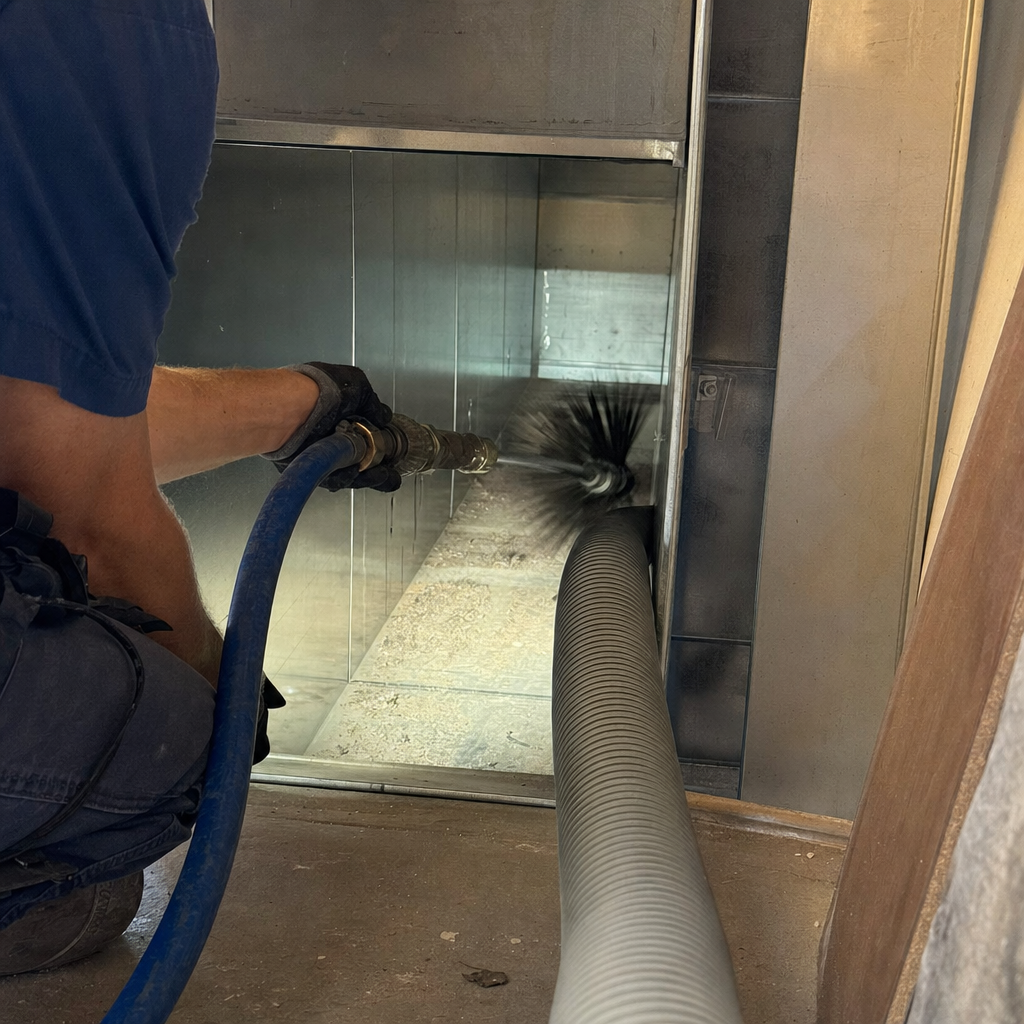
For most Allentown homes built before 1980, we recommend portable systems with mechanical agitation via Rotobrush contact-vacuum technology. The brush physically dislodges debris while simultaneous vacuum capture prevents redistribution. This controlled approach takes longer but protects fragile older systems.
Hybrid Approaches
In some cases, the right answer is sequential: seal accessible leaks first, then clean with portable equipment, then verify with post-cleaning inspection. This is where having Air Duct Cleaning in Allentown handled by a specialist with repair and sealing capability — not just cleaning — becomes essential.
The Lehigh Valley Climate Factor: Humidity, Pollen, and Seasonal Timing
Allentown’s location in the Lehigh Valley creates specific indoor air quality pressures that should inform both your duct cleaning timing and your ongoing maintenance approach. Our Seasonal Air Duct Cleaning Care for Allentown: Year-Round Homeowner’s Guide breaks down exactly when to schedule service.
Humidity Patterns
The valley geography traps moisture, particularly in summer months when relative humidity regularly exceeds 70%. Ductwork in unconditioned basements or crawl spaces — standard in Allentown’s older homes — becomes a condensation surface. We’ve inspected ducts in South Side homes where standing water in the basement had created active mold growth on duct exteriors, with spores entering the airstream through corroded metal seams.
If your home shows humidity-related issues, cleaning alone isn’t sufficient. We typically recommend integrating Honeywell or Aprilaire whole-home dehumidification solutions with duct sealing to break the moisture-debris-mold cycle.
Pollen and Agricultural Exposure
The Lehigh Valley’s mix of urban and agricultural land use means Allentown residents experience intense spring pollen (oak, maple, birch) followed by summer grass and fall ragweed peaks. These allergens enter homes through windows, doors, and ventilation systems, accumulating in ductwork. Homes near open fields or the Allentown Fairgrounds area show particularly heavy organic debris loading.
Optimal Cleaning Timing
Based on our local experience:
- Early spring (March–April): Remove winter accumulation before pollen season intensifies
- Early fall (September–October): Address summer humidity effects and prepare for closed-window heating season
- Avoid mid-winter: Frozen ground and extreme cold can complicate equipment operation; additionally, opening the system during peak heating demand stresses components
For homes with allergy-sensitive occupants, we often recommend a cleaning-sealing-sanitizing sequence timed before the worst pollen periods, using Guardsman-approved sanitizing agents where microbial concerns exist.
How to Read a Post-Cleaning Report and Verify the Work
A significant portion of the duct cleaning industry relies on homeowner trust rather than verification. Here’s how to ensure you received what you paid for.
What a Legitimate Report Includes
- Pre-cleaning documentation. Photos or video from borescope inspection showing contamination before work began. If your contractor can’t show you “before” images, they can’t prove “after” improvement.
- System map. A diagram or description of which duct runs were cleaned, which were inaccessible, and which required repair before cleaning could proceed.
- Methodology log. Equipment used, access points created, agitation method, and vacuum CFM ratings.
- Post-cleaning verification. “After” images from the same locations, plus airflow measurements where applicable.
- Debris quantification. Estimated volume or weight of material removed — not always precise, but a contractor who removed substantial debris should be able to describe it specifically (“approximately 3 gallons of fine dust and pet hair, plus disintegrated fiberglass insulation from a failed duct connection”).
Red Flags in Reporting
Vague language like “ducts cleaned” without specifying runs. No photographic evidence. Claims of “sanitizing” or “mold treatment” without identifying the specific EPA-registered product used. Missing notation of areas that couldn’t be accessed — every Allentown home has some constraint, and honest contractors document it.
In our 17 years of focused duct work, we’ve developed a reporting protocol that Larry reviews personally before leaving each job. Nearly 800 verified reviews reflect our commitment to this transparency — homeowners know exactly what was done and what remains to be addressed.
Why Duct Cleaning + Dryer Vent Inspection Is Essential in Allentown’s Older Neighborhoods
This connection is almost never made in generic duct cleaning guides, but it’s critically important for Allentown’s housing stock.
Older attached homes — row homes, twins, and small multi-family structures common in Center City and the West End — share a dangerous characteristic: dryer vents often run through walls, under floors, or across multiple joist bays before exiting, with lengths and turns that exceed modern code limits. The original installations prioritized space over safety, and decades of lint accumulation create genuine fire hazards.
When we perform Dryer Vent Cleaning in Allentown, we regularly find:
- Vent runs exceeding 25 feet with multiple 90-degree turns (modern code typically limits to 25 feet with deductions for each bend)
- Flexible transition ducting used in concealed wall cavities (now prohibited by most codes)
- Vents terminating in crawl spaces or attics rather than exterior discharge
- Complete blockages from years of compacted lint, forcing dryers to overheat
The connection to duct cleaning? Your HVAC system and dryer vent often share basement or utility space. A comprehensive indoor air quality approach addresses both simultaneously — the same visit, the same technician accountability, no handoffs. We’ve documented cases where a homeowner’s “allergy symptoms” improved not from duct cleaning alone, but from eliminating a dryer vent leak that was pumping humid, lint-laden air into the basement and being drawn into the HVAC return.
For landlords and property managers in Allentown’s multi-unit buildings, combining HVAC Cleaning in Allentown with dryer vent inspection across your portfolio creates documented safety compliance and predictable maintenance scheduling.
What Air Duct Cleaning Costs in Allentown — and What Drives the Price
Understanding pricing protects you from both bait-and-switch operators and overpayment. Here’s the Allentown market reality:
| Service Component | Typical Range | What Affects Price |
|---|---|---|
| Basic residential duct cleaning (single system, accessible) | $300–$500 | Number of registers, system accessibility, contamination level |
| Complex residential (multiple zones, limited access) | $500–$800 | Age of home, duct material fragility, need for access point creation |
| Duct sealing (Aeroseal or manual mastic) | $1,200–$2,500 | System size, leakage percentage, accessibility of leaks |
| Sanitizing/mold remediation | $150–$400 additional | Extent of microbial growth, product selection, dwell time requirements |
| Dryer vent cleaning (combined service) | $100–$250 | Vent length, number of turns, blockage severity, access requirements |
Price drivers specific to Allentown:
- Basement headroom: Many Center City basements have 6.5-foot ceilings or less, making equipment maneuvering and technician positioning more time-intensive
- Historic preservation constraints: Homes in designated historic districts may require careful register removal and restoration
- Previous contractor damage: We’ve encountered ducts punctured by inexperienced cleaners, requiring repair before any cleaning can proceed
- Asbestos-containing materials: Pre-1980 homes may require abatement coordination before ductwork can be disturbed
Be wary of advertised prices below $200 — these are almost always entry points for upselling or superficial “blow-and-go” service that doesn’t actually clean the full system. Equally, quotes above $1,000 for basic cleaning without clear justification for additional services deserve scrutiny.
Choosing a Contractor: Red Flags and Green Lights
The Allentown market includes franchise chains with rotating technicians, general HVAC companies offering duct cleaning as a seasonal add-on, and dedicated specialists. Here’s how to distinguish them:
Green Lights
- Owner or lead technician performs initial inspection personally — not a salesperson
- Specific equipment brands named and explained (Rotobrush, Nikro, Abatement Technologies) rather than vague “professional equipment” claims
- Pre-cleaning inspection with photographic documentation is standard, not extra
- Repair and sealing capability in-house — no referral to separate contractors
- Verifiable review volume (hundreds, not handfuls) with detailed customer descriptions of the work performed
- Clear explanation of limitations: what can’t be cleaned, what needs repair first, realistic outcome expectations
Red Flags
- Phone quotes without inspection — every Allentown home is different
- “Whole house” flat rates that don’t account for system size or condition
- Pressure to add sanitizing or sealant without demonstrating need
- No post-cleaning verification or documentation
- Technicians who can’t explain their equipment or methodology
- Reluctance to show proof of insurance or bonding
Larry Peterson’s 17 years as owner and Lead Technician at Sequoia Air Duct & Vent Cleaning Greater Allentown represents the model we believe homeowners deserve: executive accountability on every job, professional-grade equipment selected for your specific home, and the technical range to handle Air Duct Cleaning services, repair, sealing, and sanitizing without subcontracting.
Common Mistakes to Avoid
- Cleaning before inspecting. In Allentown’s older homes, this is the costliest error. Leaky ducts distribute debris into walls; damaged ducts may need replacement, not cleaning.
- Ignoring the return side. Many contractors focus only on supply ducts (where air exits). The return system — often dirtier — pulls air back to the HVAC unit and deserves equal attention.
- Scheduling during peak pollen season without sealing. Cleaning opens the system temporarily; without addressing how allergens re-enter, benefits are short-lived.
- Accepting “mold” claims without testing. Dark staining isn’t always mold; legitimate microbial concerns require laboratory verification, not visual assumptions.
- Neglecting dryer vents in attached homes. The fire risk and indoor air quality impact of clogged dryer vents in Allentown’s row homes and twins is systematically underestimated.
- Choosing by price alone. The lowest bid typically reflects skipped steps, uninsured operators, or equipment inadequate for your home’s specific challenges.
When to Call a Professional
Contact a dedicated duct specialist when you notice visible dust accumulation at registers, inconsistent airflow between rooms, musty odors when the system runs, or if your family experiences unexplained respiratory symptoms that worsen at home. New homeowners in Allentown should prioritize inspection — without maintenance records, you inherit unknown conditions. Property managers with tenant turnover benefit from documented baseline assessments. Sequoia Air Duct & Vent Cleaning Greater Allentown offers free estimates in Allentown — call (888) 398-0831 and Larry will assess your system personally, explain what we find, and recommend only what’s genuinely needed.
Frequently Asked Questions
Residential air duct cleaning in Allentown typically ranges from $300 to $800, depending on your home’s size, duct accessibility, and system condition. Older homes with limited basement access or fragile original ductwork fall toward the higher end. Call (888) 398-0831 for a free, specific estimate after inspection — we don’t quote blindly over the phone.
Every 3 to 5 years for most homes, but more frequently if you have pets, allergy-sensitive family members, or live in pre-1980 housing with unknown maintenance history. Allentown’s Lehigh Valley humidity and pollen loads can accelerate accumulation, particularly in homes without whole-home dehumidification.
It can reduce allergen reservoirs in your ductwork, but the benefit depends on addressing the complete pathway: filtration, sealing, humidity control, and source removal. Cleaning alone without sealing leaky returns that draw basement air, for example, provides limited lasting improvement.
For galvanized steel systems in Allentown’s row homes and twins, targeted repair and sealing is usually more cost-effective than full replacement, which may require structural access. Flexible duct from the 1960s–1970s often warrants replacement due to material degradation. We assess each system individually and explain the trade-offs.
Yes, with proper method selection. Portable HEPA systems with controlled mechanical agitation protect fragile connections and original materials. We document pre-existing conditions photographically and adjust our approach based on duct material, accessibility, and your home’s specific constraints.
Demand before-and-after photographic evidence from the same locations, a written report specifying which duct runs were addressed, and observable improvements in airflow and register cleanliness. Reputable contractors welcome this verification — it’s why we’ve maintained our review volume and rating over 17 years.
The Bottom Line
Air duct cleaning in Allentown isn’t a commodity service — it’s a technical decision that should be shaped by your home’s construction era, duct material, sealing integrity, and the Lehigh Valley’s specific climate pressures. The homeowners who get lasting value are those who invest in understanding their system before anyone touches it, who choose specialists with the equipment range and technical honesty to address what they actually find, and who verify results rather than trusting claims. Whether you’re in a Center City row home with original 1920s ductwork or a suburban split-level with 1970s flex duct, the right approach starts with inspection, proceeds with method-matched cleaning, and finishes with documented verification. Explore our more guides & resources for additional homeowner insights.
Written by Larry Peterson, Owner & Lead Technician at Sequoia Air Duct & Vent Cleaning Greater Allentown, serving Allentown since 2009.