
Last updated July 15, 2026
How to Hire a Air Duct Cleaning Contractor in Allentown: A Step-by-Step Guide
Pennsylvania does not require a specific license to offer air duct cleaning, which means the guy who cleaned carpets last week can legally show up to clean your ductwork tomorrow. In Allentown’s Lehigh Valley market, we’ve watched homeowners pay for “cleaning” that amounted to little more than a shop vac pushed into a register for twenty minutes. This Air Duct Cleaning guide gives you a structured, question-by-question framework to separate real specialists from generalists with borrowed equipment and a marketing budget. By the end, you’ll know exactly what equipment signals professionalism, how to verify credentials that actually matter, and what contract language protects you from bait-and-switch pricing.
Quick Answer
Hiring a qualified air duct cleaning contractor in Allentown means verifying NADCA certification, confirming professional-grade equipment like Rotobrush or Nikro HEPA systems, demanding an in-person pre-job walkthrough, and getting a written scope of work before any work begins. Because Pennsylvania has no mandatory duct-cleaning license, these verification steps are your only protection against substandard work.
Table of Contents
- Why Allentown’s Market Makes Vetting Essential
- The Five Equipment Questions That Disqualify Contractors
- NADCA Certification: Why It Matters More in Pennsylvania
- How to Evaluate Online Reviews Like a Pro
- The Pre-Job Walkthrough: What Professionals Do Differently
- Contract Terms That Protect You From Bait-and-Switch Pricing
- What Air Duct Cleaning Costs in Allentown
- Common Mistakes to Avoid
- When to Call a Professional
- Frequently Asked Questions
- The Bottom Line
Why Allentown’s Market Makes Vetting Essential
Allentown sits in the Lehigh Valley’s unique climate zone — hot, humid summers and cold winters that force HVAC systems to work harder than in milder regions. That seasonal strain pushes more dust, pollen, and debris through ductwork annually, making Seasonal Air Duct Cleaning Care for Allentown: Year-Round Homeowner’s Guide genuinely valuable. But it also creates a thriving market for quick-buck operators.
Here’s what makes Allentown specifically vulnerable:
- No state licensing barrier: Pennsylvania’s Home Improvement Consumer Protection Act covers many trades, but air duct cleaning falls into a gray area that doesn’t require the 12-hour training or $50,000 bond that HVAC contractors need.
- Franchise saturation: National chains with aggressive telemarketing operations target Allentown’s 125,000+ households with $49 “whole house” specials that rarely include actual duct cleaning.
- Older housing stock: Neighborhoods like West End, Emmaus-adjacent areas, and parts of South Allentown have homes built before 1980 with original ductwork — systems that require specialist knowledge, not one-size-fits-all approaches.
In our 17 years serving Allentown, we’ve been called to redo “cleaning” performed by carpet cleaners, handymen, and even pest control companies who added ductwork to their service menus. The common thread: homeowners didn’t know what questions to ask before booking.
The Five Equipment Questions That Disqualify Contractors
Equipment separates specialists from pretenders. When a contractor arrives with tools that belong in a garage, not a professional job, the results are predictable. Ask these five questions before scheduling. Wrong answers mean you keep looking.
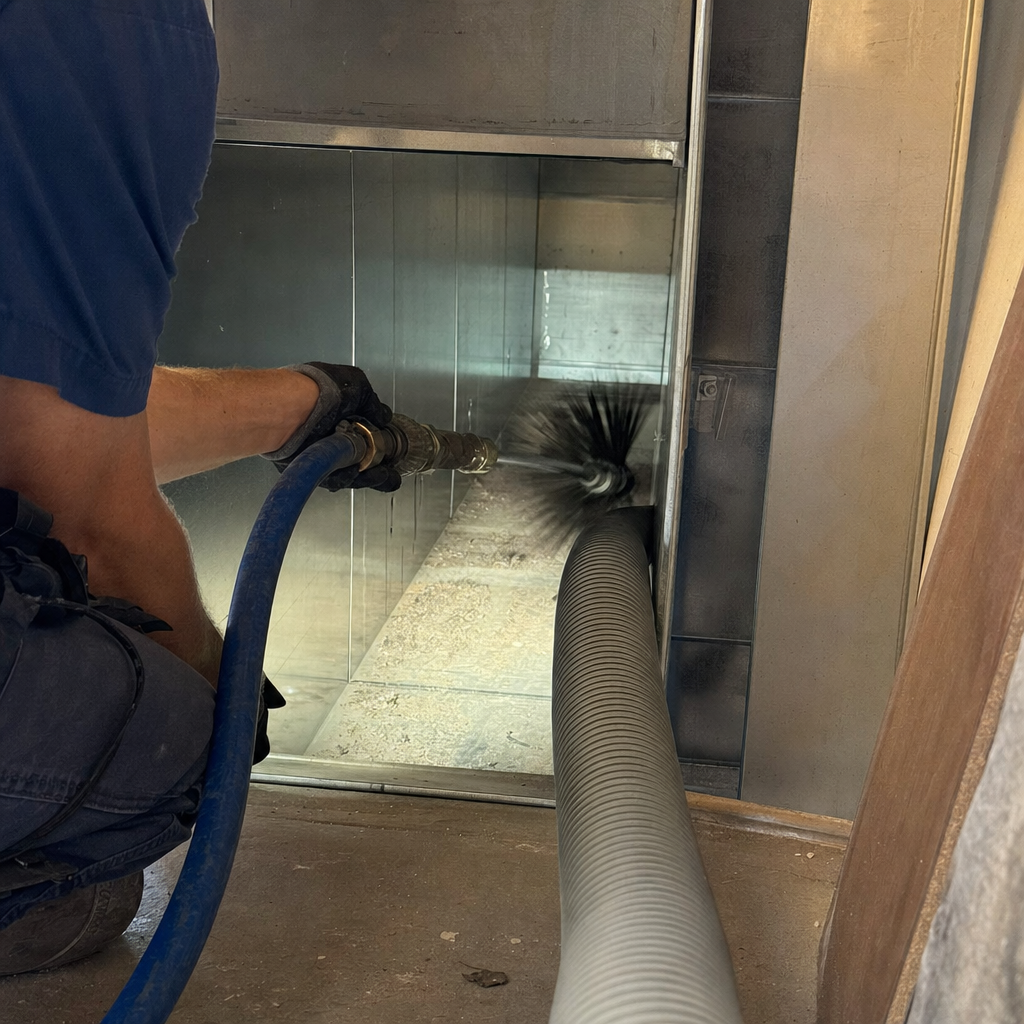
- “What vacuum system do you use?” Acceptable: Rotobrush contact-vacuum systems, Nikro HEPA-rated portable units, or Abatement Technologies negative-air machines. Red flag: “We use a standard shop vac” or “Our truck-mounted system handles everything.” Shop vacs lack the CFM (cubic feet per minute) to extract debris from deep duct runs. Truck-mounted carpet cleaning systems are designed for water extraction, not dry particulate removal from metal ductwork.
- “Do you use compressed air or mechanical agitation?” Acceptable: Pneumatic whips, skipper balls, or brush systems that physically dislodge debris. Red flag: “We just blow air through the vents.” Compressed air alone pushes debris deeper into the system or into your living space through loose connections.
- “What filtration protects my home during cleaning?” Acceptable: HEPA filtration on the vacuum exhaust, containment barriers, or portable air scrubbers like Abatement Technologies units. Red flag: Blank stare or “The vacuum has a filter.” Without HEPA containment, disturbed mold spores, dust mites, and construction debris circulate through your home during the process.
- “How do you access the main trunk lines?” Acceptable: Cut-in access panels (properly sealed afterward) or existing service openings. Red flag: “We clean from the vents only.” Return and supply trunk lines — the large rectangular ducts running through your basement or attic — collect the most debris. Cleaning only registers and vents misses 60-70% of the system.
- “What do you use for sanitizing, if needed?” Acceptable: EPA-registered antimicrobial products applied with proper dwell time and ventilation, or no sanitizing if no microbial growth is present. Red flag: “We fog everything with bleach” or “Essential oils are safer.” Bleach corrodes galvanized ductwork and creates harmful chlorine compounds when heated. Unregistered “natural” products have no EPA efficacy data.
At Sequoia Air Duct & Vent Cleaning Greater Allentown, Larry shows up personally as Lead Technician with a fleet including Rotobrush contact-vacuum systems, Nikro HEPA-rated units, and Abatement Technologies air scrubbers — the same equipment used in commercial and remediation-grade environments. We’ve invested in this specifically because Allentown’s older homes and seasonal allergen loads demand it.
NADCA Certification: Why It Matters More in Pennsylvania
The National Air Duct Cleaners Association (NADCA) is the closest thing to a legitimate credentialing body in an unlicensed state. But here’s what most Allentown homeowners don’t know: NADCA offers two distinct designations, and only one means anything for your job.
NADCA Certified Air Systems Cleaning Specialist (ASCS): Requires passing a proctored exam, continuing education, and adherence to NADCA’s Assessment, Cleaning, and Restoration (ACR) standard. This is the credential that matters.
NADCA membership only: Any company paying annual dues can display the logo. No testing, no inspection, no ongoing requirements.
To verify actual certification:
- Visit nadca.com and use their “Find a Professional” search tool
- Enter the company’s exact name — not just “Allentown duct cleaning”
- Look specifically for the ASCS badge, not just general membership
- Cross-reference the certified individual’s name with who actually performs your work
Here’s the Allentown-specific wrinkle we’ve encountered: some companies display NADCA logos on their websites without appearing in the official directory. Others list certification under a former employee or owner who no longer works there. Always verify independently.
In Pennsylvania’s unregulated environment, NADCA ASCS certification is the single most reliable indicator that a contractor understands duct system design, HVAC protection, and containment protocols. It’s not perfect — we’ve seen certified contractors cut corners — but it’s a meaningful floor that eliminates the majority of unqualified operators.
How to Evaluate Online Reviews Like a Pro
With 756 verified reviews averaging 4.8 stars, we’ve learned what review patterns reveal about operational health. Don’t just scan star ratings — read critically for these signals.
Volume thresholds matter. A company with 15 reviews, even if all 5-star, hasn’t demonstrated consistency at scale. In Allentown’s market, legitimate specialists who’ve operated for 5+ years should have 100+ reviews minimum. Volume alone doesn’t guarantee quality, but sub-50 reviews with perfect scores often indicate review-gating or selective solicitation.
Response patterns reveal management culture. Does the owner or manager respond to negative reviews, or only positive ones? Do responses offer resolution, or defensive excuses? Companies that respond to criticism with “You must be thinking of someone else” or “This customer was impossible to please” typically bring that adversarial approach to your home.
Specific language in negative reviews exposes operational problems:
- “They were done in 45 minutes” — Indicates no trunk line access, no agitation, register-only cleaning
- “Dust everywhere after they left” — No HEPA containment, poor negative air setup, or bypassed filtration
- “Price doubled when they arrived” — Classic bait-and-switch: low phone quote, upsell pressure on-site
- “Different people than I talked to” — Subcontractor model, no owner accountability
- “Couldn’t answer basic questions about my system” — Untrained technicians following a script
Platform distribution matters too. Reviews concentrated exclusively on one platform (especially the company’s own website) warrant skepticism. Cross-reference Google, Yelp, Facebook, and industry-specific sites. In Allentown, we’ve found that legitimate operations have presence across multiple platforms with consistent themes — not identical copy-pasted text, but similar descriptions of punctuality, thoroughness, and communication.
The Pre-Job Walkthrough: What Professionals Do Differently
Any contractor who quotes a firm price over the phone without seeing your system is either guessing or planning to upsell. Here’s what a legitimate pre-job walkthrough includes, and what shortcuts signal trouble.
A professional walkthrough covers:
- System type and age: Flexible ductwork, fiberglass-lined metal, or bare galvanized steel each require different cleaning approaches. Allentown’s 1960s-1980s ranch homes in areas like Salisbury Township often have original fiberglass ductboard that degrades under aggressive mechanical cleaning.
- Access points: Where will the vacuum connect? Are there existing service openings, or do new access panels need cutting and sealing? In West Allentown’s tighter lot configurations, equipment placement affects hose routing and protection of landscaping.
- Contamination assessment: Visible mold, excessive dust loading, construction debris, or pest evidence. This determines whether standard cleaning suffices or if remediation protocols are needed.
- HVAC component condition: Blower wheel, evaporator coil, and filter status. Cleaning ducts with a fouled blower or clogged coil is incomplete — you’ll recontaminate immediately.
- Register and vent count: The actual basis for fair pricing, not “number of rooms” or “square footage” guesses.
Red flags during walkthroughs:
- Rushing through in under 10 minutes
- No inspection of basement/crawlspace trunk lines
- Immediate pressure to sign before you’ve compared options
- Verbal-only quotes with no written scope
- Dismissal of visible mold or damage with “We’ll handle that when we’re here”
At Air Duct Cleaning in Allentown, Larry Peterson conducts every pre-job assessment personally. In 17 years of focused duct work, we’ve learned that Allentown’s varied housing stock — from Center City’s brick row homes to the sprawling 1990s builds near Trexler Park — each presents unique access challenges that phone quotes can’t capture.
Contract Terms That Protect You From Bait-and-Switch Pricing
The $99 whole-house special that balloons to $800 on arrival is so common it has a name in the industry: the “blow-and-go” upsell. Protect yourself with specific contract language.
Insist on a written scope of work specifying:
- Exact equipment to be used: Brand and type of vacuum system, agitation method, and filtration. “Professional equipment” means nothing — get specifics.
- What “cleaning” includes: Supply ducts, return ducts, trunk lines, registers, grilles, and boots? Or just “vents”? The difference is substantial.
- HVAC component scope: Is blower wheel cleaning included? Coil inspection? These significantly impact total system cleanliness.
- Access panel handling: Who cuts, who seals, what materials used? Unsealed access holes leak conditioned air and draw attic or crawlspace contaminants.
- Sanitizing as separate line item: If microbial growth requires treatment, this should be priced separately with product EPA registration numbers noted.
- Final verification method: Visual inspection? Before/after photos? Video scope? Some method of confirming work completion should be specified.
Language that signals bait-and-switch risk:
- “Technician will assess and recommend additional services as needed” — Unlimited upsell authorization
- “Starting at” pricing without ceiling — The “at” is doing heavy lifting
- “Whole house” without register count — Ambiguous scope allows arbitrary add-ons
- “Required sanitizing” bundled into base price — Legitimate sanitizing is situational, not automatic
- Vague equipment descriptions like “commercial-grade” or “industrial-strength” — No verifiable standard
For Dryer Vent Cleaning in Allentown specifically — often bundled with duct cleaning — demand similar specificity: length of vent run cleaned, roof termination handling, and whether booster fan maintenance is included. Allentown’s multi-story homes in historic districts often have long, convoluted dryer vent runs that require specialized equipment beyond standard duct cleaning tools.
What Air Duct Cleaning Costs in Allentown
Legitimate air duct cleaning in Allentown’s market carries specific cost ranges based on system size and complexity. Prices significantly below these thresholds indicate corner-cutting; significantly above requires justification.
| Service Component | Typical Range (Allentown Market) | What Affects Price |
|---|---|---|
| Standard residential duct cleaning (1,500-2,500 sq ft) | $400 – $700 | Register count, accessibility, contamination level |
| Larger homes or complex systems (3,000+ sq ft, zoned) | $700 – $1,200 | Multiple HVAC units, extensive trunk lines, crawlspace access |
| HVAC component cleaning (blower, coil) | $150 – $350 additional | Coil accessibility, degree of fouling |
| Dryer vent cleaning (standard run) | $120 – $200 | Run length, termination height, blockage severity |
| Duct repair/sealing (per project) | $200 – $800 | Accessibility, materials, extent of damage |
| EPA-registered sanitizing treatment | $100 – $250 additional | System size, product used, application method |
Allentown-specific factors that push costs higher: homes with original ductwork in neighborhoods like Old Allentown or the 19th Street Theatre district often require more careful handling; post-renovation cleaning after the city’s building boom in areas near the Waterfront project typically involves construction debris removal; and seasonal demand spikes — especially pre-winter heating system prep — can affect scheduling availability though shouldn’t dramatically alter pricing from established operators.
Be immediately suspicious of any quote below $250 for a complete system. At that price point, no legitimate operator can cover labor, equipment maintenance, insurance, and disposal costs while performing thorough work.
Common Mistakes to Avoid
- Booking based on lowest price alone: In Allentown’s unregulated market, the cheapest quote typically means the least actual cleaning. We’ve redone $89 specials that left homeowners with stirred-up dust and damaged registers.
- Assuming HVAC companies automatically do better duct cleaning: Most generalist HVAC contractors in the Lehigh Valley treat duct cleaning as a low-margin add-on, sending junior techs with minimal training and borrowed equipment. HVAC Cleaning in Allentown requires different expertise than system installation or repair.
- Neglecting to verify who’s actually performing the work: Some companies with strong reviews send different technicians than the owner who built the reputation. Ask specifically: “Will the person I meet for the walkthrough be on the job?”
- Ignoring seasonal timing: Allentown’s pollen seasons — late April through June, and again in September — create peak demand that strains scheduling. Booking during shoulder seasons (March, October-November) often yields more flexible appointments without compromising results.
- Failing to prepare the home: Move furniture away from registers, secure pets, and ensure basement/attic access. Technicians who don’t mention preparation may not plan thorough register-by-register work.
- Accepting verbal warranties: Without written documentation of what’s guaranteed and for how long, “satisfaction guaranteed” is meaningless. Reputable operators specify what recourse exists if results don’t meet expectations.
- Overlooking dryer vent bundling: Allentown’s fire statistics show dryer lint fires remain a significant risk, especially in older multi-family buildings. Bundling dryer vent cleaning with duct cleaning is more efficient and often more economical, but verify the dryer vent scope is equally specific in writing.
When to Call a Professional
Certain situations in Allentown homes demand immediate professional assessment rather than “wait and see.” Visible mold growth inside registers or ductwork, musty odors that intensify when HVAC runs, unexplained respiratory symptoms that improve when away from home, or post-renovation dust infiltration all warrant prompt attention. After water damage or flooding — increasingly relevant in Allentown’s low-lying areas near the Little Lehigh Creek — duct systems can harbor hidden moisture that propagates mold within 48-72 hours.
If you’ve never had ducts cleaned in a home older than 15 years, or you’ve recently purchased a home with unknown maintenance history, scheduling an assessment provides baseline information even if immediate cleaning isn’t required. Sequoia Air Duct & Vent Cleaning Greater Allentown offers free estimates in Allentown — call (888) 398-0831 to schedule a no-pressure walkthrough with Larry Peterson, who serves as Lead Technician on every job.
Frequently Asked Questions
Professional air duct cleaning in Allentown typically ranges from $400 to $700 for a standard 1,500-2,500 square foot home, with larger or more complex systems running $700 to $1,200. Factors affecting price include total register count, accessibility of trunk lines, contamination level, and whether HVAC components like blower wheels and coils need simultaneous cleaning. Call (888) 398-0831 for an exact quote — estimates are free.
No — Pennsylvania has no state licensing requirement specifically for air duct cleaning, which is precisely why NADCA certification matters more here than in regulated states. NADCA’s Certified Air Systems Cleaning Specialist (ASCS) designation requires passing a proctored exam and continuing education, providing a verifiable credential in an otherwise unregulated field. Always verify certification independently at nadca.com rather than trusting website logos alone.
Every 3-5 years for typical households, though Allentown’s seasonal extremes and pollen loads push some homes toward the shorter end of that range. Homes with allergy-sensitive residents, pets, recent renovations, or located near active construction should consider more frequent assessment. In our experience across Allentown’s neighborhoods, homes near major roadways or in the city’s older industrial-adjacent areas accumulate particulate faster and benefit from 2-3 year intervals.
DIY duct cleaning with household vacuums or brush kits available at hardware stores risks damaging flexible ductwork, dislodging connections, and disturbing contaminants without proper containment. The equipment question matters: without professional-grade negative air and HEPA filtration, you’re likely redistributing debris throughout your home. For accessible register covers and visible vent surfaces, careful DIY cleaning is reasonable; for trunk lines and deep system work, professional equipment and training significantly outperforms consumer alternatives.
Thorough cleaning of a standard Allentown home requires 3-5 hours for a two-person team using proper equipment. “Cleanings” completed in 60-90 minutes almost certainly skipped trunk lines, used inadequate agitation, or lacked proper setup and breakdown. Our jobs with Rotobrush and Nikro systems, including pre-job walkthrough and post-cleaning verification, typically run 4-6 hours — a timeframe that reflects complete work, not rushed coverage.
Air duct cleaning addresses the distribution network — supply and return ducts, registers, and grilles. HVAC cleaning includes the mechanical components: blower wheel, evaporator coil, heat exchanger, and cabinet interior. Cleaning ducts without addressing a fouled blower or clogged coil recontaminates the system immediately. At Sequoia Air Duct & Vent Cleaning Greater Allentown, we assess both and recommend combined service when components show significant buildup, which is common in Allentown’s extended heating and cooling seasons.
The Bottom Line
Hiring an air duct cleaning contractor in Allentown requires active verification because Pennsylvania’s lack of specific licensing places the entire vetting burden on you. The framework is straightforward: confirm NADCA ASCS certification independently, ask the five equipment questions that expose inadequate tools, demand an in-person walkthrough before any firm quote, and get written scope of work that specifies exactly what “cleaning” includes. Review patterns reveal operational truth more reliably than star averages alone. Price sensitivity is natural, but in this market, significantly low quotes predict incomplete work that costs more to redo. The specialist who arrives with professional-grade equipment, specific training, and owner accountability — who can explain exactly what your Allentown home’s system needs and why — earns the premium through results you can verify. See our more guides & resources for ongoing homeowner education.
Written by Larry Peterson, Owner & Lead Technician at Sequoia Air Duct & Vent Cleaning Greater Allentown, serving Allentown since 2009.