
Last updated July 15, 2026
Seasonal Air Duct Cleaning Care for Allentown: Year-Round Homeowner’s Guide
The worst time to discover your ductwork has a mold problem is the first cold day of October when you turn the heat on after six months and the smell hits every room at once. In our 17 years serving Allentown, that late-September furnace startup has consistently been the single highest-volume emergency call period for indoor air quality problems in the Lehigh Valley — not because the mold grew overnight, but because homeowners treated duct care as a one-and-done annual checklist item instead of a seasonal discipline. This guide breaks down what actually happens inside your duct system during each of Allentown’s four distinct seasons, when to intervene, and how to build a maintenance rhythm that prevents those October surprises. For more guides & resources, explore our full knowledge base.
Quick Answer
Allentown homeowners should schedule professional our Air Duct Cleaning services once in late spring (after heating season residue settles) and once in early fall (before furnace startup), with dryer vent cleaning each summer and continuous filter monitoring year-round. Homes with pets, recent renovations, or allergy-sensitive occupants need more frequent attention — typically a 12- to 18-month rotation rather than the generic “every 3-5 years” interval national chains promote.
Table of Contents
- Spring: Clearing Winter’s Heating Residue
- Summer: Managing Humidity and Condensation Risk
- Fall: The Pre-Heating-Season Inspection Checklist
- Winter: Monitoring Air Quality During Continuous Heating
- Building Your Multi-Year Rotation Schedule
- Common Mistakes to Avoid
- When to Call a Professional
- Frequently Asked Questions
Spring: Clearing Winter’s Heating Residue
After six months of continuous furnace operation, Allentown’s duct systems carry a specific load that many homeowners don’t recognize until we open the registers. The Lehigh Valley’s winter heating demand — running from late October through mid-April most years — forces warm, dry air through supply ducts at temperatures that bake fine particulates onto interior surfaces. What we find inside spring-cleaning appointments tells the story: a layer of carbonized dust, pet dander that has thermally set into the metal, and in older Allentown homes near the Jordan Creek watershed, trace mineral deposits from hard water humidifier attachments.
Post-heating-season is the optimal cleaning window for most Allentown homes for three structural reasons. First, the system has just completed its heaviest use cycle, so contaminant loading is at its annual peak — removing it now prevents that residue from becoming a seedbed for spring pollen and summer mold. Second, outdoor humidity is still moderate in April and May, so cleaned ducts dry thoroughly before the muggy season arrives. Third, scheduling before the summer HVAC rush means you’re not competing with emergency cooling calls for technician availability.
In our work across Allentown neighborhoods from West End to East Side to the South Side historic districts, we’ve documented consistent spring patterns:
- Homes with forced-air furnaces over 15 years old show significantly higher carbonized dust loading due to incomplete combustion and lower static pressure
- Properties near major corridors like Hamilton Boulevard or Tilghman Street accumulate more exterior particulate that infiltrates return pathways during winter’s negative pressure cycles
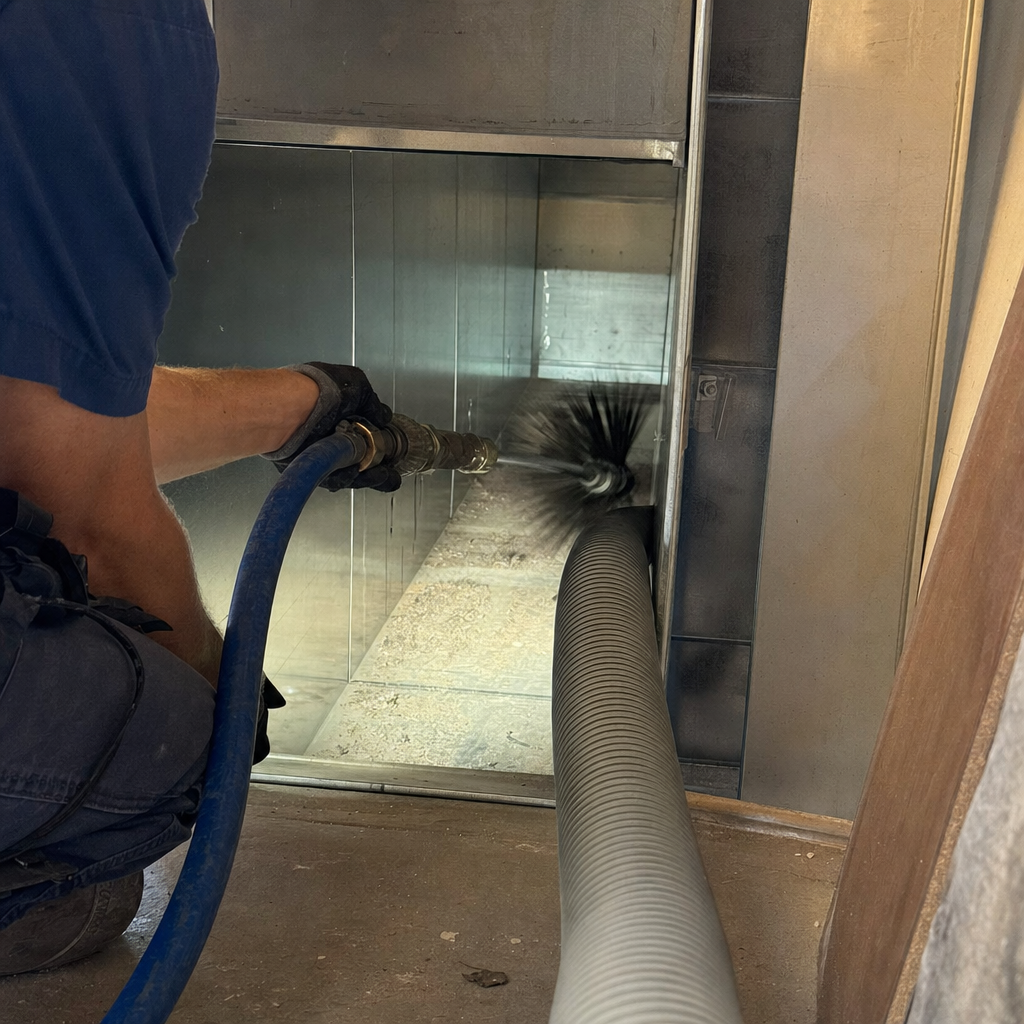
- Houses with fiberglass duct board from the 1980s-90s trap residue in porous surfaces that standard vacuuming won’t address — these need contact-brush agitation with Rotobrush systems to actually dislodge material
We typically recommend April or May appointments for our Allentown clients, timed after the final heating cycle but before consistent air conditioning use begins. For homes with allergy-sensitive occupants, pairing this cleaning with an Aprilaire media filter upgrade captures the spring tree pollen load that enters through fresh air intakes.
Summer: Managing Humidity and Condensation Risk
Allentown’s summer humidity profile creates a distinct duct system stress point that homeowners in drier climates never face. When outdoor dew points climb into the mid-60s — common from late June through August in the Lehigh Valley — cooled supply ducts can drop below the dew point temperature at their exterior surfaces or at points where insulation has degraded. This produces condensation inside wall cavities, at duct joints, and particularly at floor registers in basement-level systems.
What this looks like at the register level: water staining around supply vents, a musty smell when the AC first cycles on, or in advanced cases, visible mold spotting on ceiling diffusers. We’ve responded to summer calls in Allentown’s older housing stock — particularly the pre-war homes in the 1st and 6th Wards — where uninsulated metal duct runs through plaster walls have created chronic condensation paths that degraded surrounding building materials.
The maintenance priorities shift in summer from debris removal to moisture management:
- Inspect visible duct runs monthly for condensation signs, especially in unfinished basements where temperature differentials are greatest
- Verify that your condensate drain line is clear — a backed-up primary drain can raise ambient humidity in mechanical rooms and accelerate duct surface wetting
- Check that bathroom and kitchen exhaust fans actually vent outside, not into attic spaces or wall cavities where moisture migrates into return air pathways
- Monitor supply register airflow temperature — registers blowing air below 55°F in high-humidity conditions increase condensation risk significantly
For Allentown homes with central air conditioning, we recommend a mid-summer filter inspection rather than waiting for the quarterly change interval. The combination of high outdoor pollen, increased fan runtime, and moisture loading clogs filters faster than winter heating operation. A restricted filter drops evaporator temperature further, exacerbating the condensation cycle.
Our HVAC Cleaning in Allentown service addresses the full cooling season profile: coil cleaning to restore proper temperature exchange, drain pan treatment to prevent biological growth, and duct inspection for moisture intrusion points that generic cleaning misses.
Fall: The Pre-Heating-Season Inspection Checklist
Fall is the critical prevention window — the six weeks between Labor Day and Halloween when Allentown homeowners can either head off the October emergency or guarantee it. Understanding Air Duct Cleaning Permits, Codes & Inspections in PA: What You Need to Know helps ensure your service meets all requirements. The specific threat isn’t mysterious: after five months of air conditioning, dust and moisture have accumulated in ductwork that will sit stagnant for several weeks, then be force-heated and distributed throughout the house on first furnace startup.
The outdoor intake screens deserve specific attention after leaf-drop, and this is where we see the most preventable fall failures. Allentown’s mature tree canopy — particularly in the Trexler Park area, the Rose Garden district, and along the Little Lehigh Creek greenway — produces heavy leaf and seed debris that clogs exterior intake hoods and rooftop vents. A blocked combustion air intake doesn’t just reduce efficiency; it can create negative pressure that draws garage fumes, attic insulation particles, or crawlspace moisture into return pathways.
Our Air Duct Cleaning Maintenance Checklist for Allentown Homeowners pre-heating inspection protocol includes:
- Visual intake screen cleaning — removing leaf debris, seed pods, and insect nests that accumulated since spring
- Return grille and register inspection for dust buildup that would burn off and circulate on first heating cycle
- Furnace cabinet and blower compartment check for moisture staining or rodent activity during the idle summer period
- Filter replacement with heating-season appropriate media — typically MERV 11-13 for Allentown’s winter particulate load, versus the lighter summer filters
- Thermostat heat-cycle test to verify proper ignition sequence before the first cold morning demand
The timing matters: we schedule these inspections in mid-September to early October, before the first sustained cold snap that triggers system-wide startup. In 2023, Allentown’s first frost came October 17th; in 2022, it was October 2nd. The homeowners who called us September 20th had clean systems ready. Those who waited until they smelled something on October 15th were competing for emergency slots.
For properties with outdoor dryer vents, fall is also the optimal window for Dryer Vent Cleaning in Allentown — lint accumulation accelerates in summer’s high-humidity drying cycles, and the longer fall heating season increases dryer runtime and fire risk.
Winter: Monitoring Air Quality During Continuous Heating
Allentown’s winter heating season — typically 170-190 days of furnace operation — creates the longest continuous stress period for duct systems. The specific challenge isn’t just debris accumulation; it’s the alteration of indoor air chemistry that occurs when homes are sealed against cold and heated air recirculates with minimal fresh air exchange.
We’ve measured this in Lehigh Valley homes: winter indoor particulate concentrations routinely run 3-5 times higher than summer levels due to reduced ventilation, increased cooking and candle use, and the simple physics that warm, dry air keeps particles suspended longer. Your duct system becomes the distribution network for whatever enters the air — pet dander that would have settled in summer stays aloft, cooking aerosols that would have vented through open windows recirculate, and the fine ash from wood-burning supplements (common in Allentown’s older neighborhoods with functioning fireplaces) loads filters faster than standard intervals anticipate.
Mid-season filter upgrades are warranted under specific conditions we see repeatedly in Allentown:
- Homes with continuous furnace operation below 20°F outdoor temperature — the extended runtime loads filters faster than the standard 90-day interval
- Properties using supplemental wood or pellet heat — combustion particulate bypasses the main filter and deposits in return ductwork
- Homes with new carpeting or recent furniture purchases — off-gassing volatile organic compounds (VOCs) concentrate in sealed winter environments
- Residences with indoor smokers or frequent candle burning — these sources produce sub-micron particles that standard filters don’t capture
We recommend a January filter inspection for most Allentown clients — a quick visual check that takes two minutes and prevents the restricted-airflow problems that damage blower motors and reduce heat delivery to second-floor rooms. For homes with Aprilaire or Honeywell whole-house air cleaners, this is also the interval to check media cartridge condition; the high winter loading typically requires mid-season replacement rather than the annual interval suggested for milder climates.
The other winter monitoring priority: humidity balance. Allentown’s cold-season outdoor air holds minimal moisture, and heated indoor air often drops below 30% relative humidity. This isn’t just a comfort issue — overly dry air increases static electricity, cracks woodwork, and paradoxically makes particulate matter more irritating to respiratory systems. However, over-humidification creates its own duct problems: excess moisture at cold duct surfaces, microbial growth in drain pans, and mineral dust from poorly maintained humidifiers. We target 35-45% relative humidity for Allentown winter conditions, verified with a calibrated hygrometer rather than the imprecise dial on most thermostat displays.
Building Your Multi-Year Rotation Schedule
The “every 3-5 years” interval promoted by national duct cleaning franchises is a marketing convenience, not a technical standard. In 17 years of focused duct work across Allentown and the Lehigh Valley, we’ve never seen two homes with identical maintenance needs. Your rotation should reflect actual loading factors, not a calendar abstraction.
Here’s the framework we use when consulting with Allentown homeowners:
| Home Profile | Recommended Rotation | Primary Services |
|---|---|---|
| Single occupants, no pets, no renovations, standard filtration | 24-month full cleaning; annual filter upgrade | Air duct cleaning, dryer vent every 2 years |
| Family with children, one pet, standard activity | 18-month full cleaning; bi-annual filter inspection | Air duct cleaning, annual dryer vent, mid-cycle HVAC check |
| Multiple pets, allergy-sensitive occupants, or recent renovation | 12-month full cleaning; quarterly filter monitoring | Full scope: duct cleaning, sanitizing, dryer vent, filter media |
| Investment property, tenant turnover, or multi-unit | Between-tenant cleaning; annual inspection | Duct cleaning, dryer vent, basic IAQ assessment |
Renovation history is the most underestimated factor in Allentown’s housing market. The city’s active historic preservation program and steady gentrification in neighborhoods like Old Allentown and the Arts District means many homeowners are living through active construction cycles. Drywall dust, flooring adhesives, and insulation particulate enter duct systems during renovation and continue circulating for years if not addressed. We recommend post-renovation cleaning within 30 days of project completion, then a shortened rotation for the first two years afterward.
Pet ownership changes the calculation specifically because of dander’s physical properties. Cat and dog dander is barbed and electrostatically charged — it adheres to duct surfaces more tenaciously than standard household dust and re-aerosolizes with every system cycle. Homes with multiple pets or large breeds need the 12-month interval not because of odor concerns, but because accumulated dander loading actually changes duct friction and reduces airflow efficiency.
For Allentown’s rental market — particularly the student housing near Muhlenberg and Cedar Crest, and the multi-family conversions in center city — we recommend documented annual service that protects both tenant health and property condition. Larry shows up personally as Lead Technician on these properties, so landlords get consistent assessment quality and direct accountability rather than varying subcontractor reports.
Our Air Duct Cleaning in Allentown service includes a documented condition assessment that helps build this multi-year record, so you’re not guessing about intervals based on calendar memory.
Common Mistakes to Avoid
- Treating duct cleaning as a one-time event. Allentown’s four-season climate creates distinct loading cycles; a single cleaning ignores the cumulative effect of pollen season, humidity exposure, heating residue, and renovation debris across multiple years.
- Ignoring outdoor intake maintenance. After Allentown’s heavy leaf drop in late October, clogged intake screens force systems to draw air from unintended pathways — garages, attics, crawlspaces — introducing contaminants that bypass filtration entirely.
- Using the cheapest available filter year-round. Fiberglass panel filters protect equipment but don’t improve air quality; they also load faster in Allentown’s pollen-heavy spring and force the blower to work harder, increasing energy costs.
- Scheduling fall cleaning too late. Waiting until you smell something on first furnace startup means you’re already circulating contaminants; the optimal fall window closes by October 15th most years.
- Neglecting dryer vent cleaning. Allentown’s longer heating season increases dryer runtime, and lint accumulation is the leading preventable cause of residential fires; this isn’t an “add-on” but a parallel safety system.
- Assuming new construction means clean ducts. We’ve found construction debris — drywall screws, insulation scraps, sawdust — in duct systems of Allentown homes less than two years old; builder “rough cleans” don’t address interior duct surfaces.
- DIY cleaning with consumer-grade equipment. Shop vacuums and brush kits can’t generate the negative pressure or HEPA containment of professional systems; without proper isolation, you risk contaminating living spaces rather than removing debris.
When to Call a Professional
Certain conditions warrant immediate professional assessment rather than continued monitoring. Visible mold growth on registers or in duct openings, persistent musty odors that don’t resolve with filter changes, water staining around supply vents, or sudden reductions in airflow to specific rooms all indicate system problems that DIY approaches won’t resolve. In homes with occupants experiencing unexplained respiratory symptoms, chronic sinus irritation, or worsening asthma control, duct contamination should be evaluated as a potential contributing factor.
Sequoia Air Duct & Vent Cleaning Greater Allentown offers free estimates in Allentown — call (888) 398-0831. Larry Peterson serves as Lead Technician on every job, bringing 17 years of focused duct and indoor air quality experience directly to your property. Our equipment fleet includes Rotobrush contact-vacuum systems, Nikro HEPA-rated negative air machines, and Abatement Technologies portable air scrubbers — the same tools deployed in commercial remediation environments, not consumer-grade alternatives. From cleaning to sealing, we handle the full scope in one visit without subcontracting handoffs.
Frequently Asked Questions
Professional air duct cleaning for a typical Allentown single-family home ranges from $400–$700 for a complete system, with larger homes or those with multiple HVAC zones running higher. Dryer vent cleaning typically adds $120–$180, and full HVAC cleaning with coil and blower service runs $600–$900. Call (888) 398-0831 for an exact quote — estimates are free and include a full system assessment.
We perform duct cleaning year-round in Allentown, including mid-winter appointments. Winter cleaning requires brief system shutdown during the service — typically 3-4 hours — so we schedule around your heating needs and can section the work to maintain partial heat. For homes with elderly occupants or infants, we often recommend late-morning starts when outdoor temperatures are highest.
Mold typically presents as dark, patchy staining with a distinct musty or earthy odor, while dust accumulation is uniform gray and odorless. In Allentown’s humid summer conditions, mold favors the supply side of cooling systems where condensation occurs; in winter, it appears near humidifier attachments or leak points. If you’re uncertain, we offer visual assessment with borescope inspection — no charge with any scheduled service.
Localized damage — disconnected joints, small punctures, or failed sealing at boots — is typically repairable at $200–$400 per location. Extensive degradation of flexible duct, collapsed sections, or asbestos-containing materials in pre-1980 Allentown homes usually requires replacement. We assess both options during cleaning and provide documented recommendations; our duct repair and sealing service uses Guardsman mastic and mechanical fastening for repairs that last.
Standard 1-inch pleated filters need replacement every 60-90 days during Allentown’s heating and cooling seasons; thicker media filters (4-5 inch) typically last 6-12 months. Homes with pets, smokers, or near major roads like Route 22 or I-78 should inspect monthly and replace when visibly loaded. Never exceed manufacturer intervals — restricted airflow damages blowers and reduces equipment life.
Same-day service is often available for urgent situations — first furnace startup odors, visible mold discovery, or post-water-damage assessment. Call (888) 398-0831; if we’re fully booked, we maintain a cancellation list and can typically respond within 24-48 hours for Allentown addresses. Emergency assessments are prioritized for homes with infants, elderly residents, or immunocompromised occupants.
The Bottom Line
Allentown’s four-season climate demands a four-season approach to duct care. Spring clears the heating residue that would otherwise seed summer mold. Summer manages the humidity that creates condensation risk unique to the Lehigh Valley. Fall prevents the October emergency through pre-startup inspection and intake maintenance. Winter monitors filter loading and air chemistry during the longest continuous operation period. Treating this as a single annual event ignores the specific stress each season applies — and guarantees that at least one season will surprise you. Build your rotation around your home’s actual occupancy, pet status, and renovation history; use professional-grade equipment and documented assessment; and schedule the critical fall window before the first cold snap arrives.
Written by Larry Peterson, Owner & Lead Technician at Sequoia Air Duct & Vent Cleaning Greater Allentown, serving Allentown since 2009.