
Last updated July 15, 2026
Air Duct Cleaning Permits, Codes & Inspections in PA: What You Need to Know
Most Allentown homeowners assume air duct cleaning falls into the same unregulated category as carpet cleaning or pressure washing — until their technician pulls back an insulation sleeve and finds a collapsed flex duct, a disconnected return, or mold staining that requires remediation-level work. In that moment, what started as a straightforward maintenance visit can cross into permit territory, and the property owner who didn’t understand the boundary is left guessing whether their contractor is operating legally. We’ve been cleaning ducts across Allentown for 17 years, and we’ve learned that the permit question isn’t about our Air Duct Cleaning services themselves — it’s about what you discover while you’re inside the system.
Quick Answer
Standard air duct cleaning — the mechanical removal of dust, debris, and contaminants from existing ductwork without modification — requires no permit under Pennsylvania’s Uniform Construction Code. However, any repair, replacement, or modification of ductwork components, including reattaching disconnected sections or replacing deteriorated flex duct, may trigger permit requirements and must be performed by a licensed HVAC contractor. Mold remediation inside ductwork is a separate regulatory category entirely, requiring specialized certification and often notification to the Pennsylvania Department of Environmental Protection.
Table of Contents
- Pennsylvania’s Uniform Construction Code: Where Cleaning Ends and Construction Begins
- How Allentown’s Building Department Handles HVAC-Adjacent Work
- What Landlords and Property Managers Must Document for Rental Compliance
- Mold Remediation vs. Standard Cleaning: Separate Regulatory Categories
- How to Structure a Scope of Work That Avoids Unpermitted Modifications
- Red Flags: When a “Cleaning” Job Actually Requires Permits
- Common Mistakes to Avoid
- When to Call a Professional
- Frequently Asked Questions
Pennsylvania’s Uniform Construction Code: Where Cleaning Ends and Construction Begins
The Pennsylvania Uniform Construction Code (UCC), adopted under Act 45 of 1999 and updated through the International Code Council family of standards, governs all building construction, alteration, and repair work in the Commonwealth. For air duct systems, the critical distinction lies between maintenance/cleaning and mechanical system modification.
Under the UCC’s International Mechanical Code (IMC) provisions as adopted by Pennsylvania, standard air duct cleaning — defined as the mechanical agitation and extraction of accumulated particulate matter from existing, intact ductwork — does not constitute “construction” or “alteration.” No permit is required, no licensed tradesperson is mandated, and no inspection is triggered. This is why a dedicated duct cleaning specialist like Sequoia Air Duct & Vent Cleaning Greater Allentown home can perform this work directly.
The boundary shifts when any of these conditions occur:
- Physical modification of ductwork: Cutting, extending, resizing, or rerouting any duct component
- Component replacement: Installing new flex duct, rigid duct, fittings, or boots to replace deteriorated existing materials
- Reconnection of separated systems: Reattaching ductwork that has become disconnected, which constitutes repair work under the IMC
- Sealing with permanent materials: Application of mastic or foil tape to seal leaks may fall into a gray area; mechanical cleaning alone does not
- Integration with HVAC equipment: Any work requiring access to or modification of the furnace, air handler, or heat pump
Here’s where Pennsylvania’s regulatory framework creates practical confusion. The UCC delegates enforcement to municipal building departments, which means Allentown interprets and applies these standards locally. In our 17 years of focused duct work across the Lehigh Valley, we’ve encountered building inspectors who view reconnection of a fallen flex duct as maintenance (no permit), and others who classify the identical work as repair requiring a licensed HVAC contractor and permit. The inconsistency isn’t a flaw to exploit — it’s a risk to manage.
For property owners, the safest framework is this: if a technician’s hand enters the ductwork with a cleaning tool only, it’s cleaning. If the technician’s tools include shears, crimpers, or new materials, the work has likely crossed into regulated territory. Larry shows up personally as Lead Technician on every Sequoia job, and we’ve developed a clear protocol: we document pre-existing conditions photographically, flag any component that requires more than cleaning, and present the homeowner with a delineated scope before any boundary-crossing work begins.
How Allentown’s Building Department Handles HVAC-Adjacent Work
Allentown’s Building Standards Office operates under the Lehigh Valley’s most active municipal inspection program, with specific procedures for HVAC work that duct cleaning contractors must understand — particularly when servicing rental properties or commercial buildings where third-party liability exposure is higher.
The city’s inspection trigger framework works as follows:
- Permit application: Required for any HVAC system installation, alteration, or repair that modifies existing ductwork routing, capacity, or materials. Standard cleaning is exempt.
- Licensed contractor requirement: All permitted HVAC work must be performed by a contractor holding Pennsylvania Home Improvement Contractor (HIC) registration and, for refrigerant-bearing systems, EPA Section 608 certification. Allentown’s building department verifies these credentials at permit issuance.
- Inspection scheduling: Rough and final inspections are mandated for permitted work. The building department typically schedules within 3-5 business days of request, though peak seasons (May-September) extend this timeline.
- Certificate of occupancy tie-ins: For rental properties, any permitted HVAC work must be closed with a final inspection before the certificate of occupancy or rental license renewal can proceed.
Allentown’s climate creates specific ductwork stress patterns that increase the likelihood of discovering permit-triggering conditions mid-cleaning. The Lehigh Valley’s freeze-thaw cycles, with winter temperatures regularly dropping below 20°F and summer humidity spiking above 70%, cause thermal expansion and contraction in duct materials. In older Allentown neighborhoods like the West End, Center City, and the Seventh Street corridor, we’ve found that galvanized steel ducts from the 1950s-1970s have developed seam separations that appear during cleaning. In newer construction around Trexler Park and the Airport Road corridor, flex duct in unconditioned attics has deteriorated from UV exposure where installers left insulation gaps.
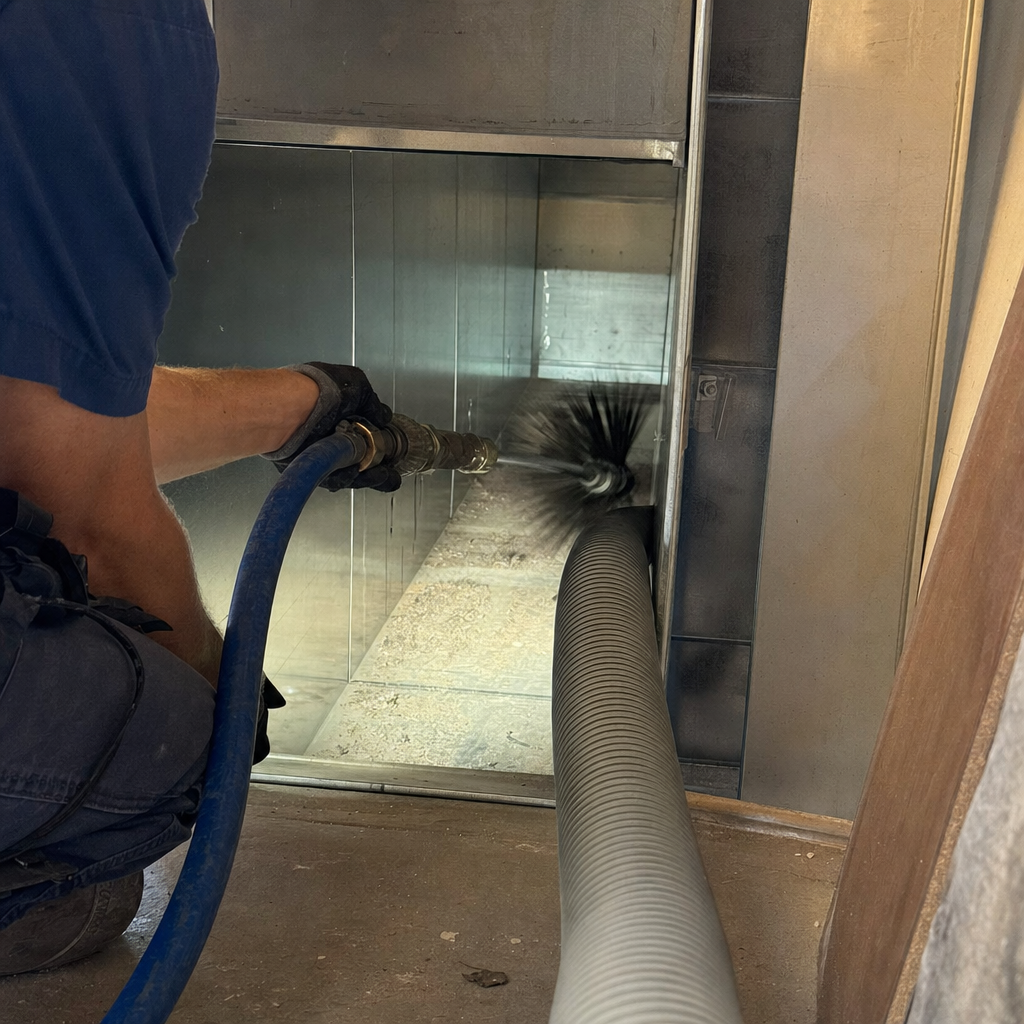
When our Rotobrush contact-vacuum system or Nikro HEPA-rated unit reveals these conditions, we stop, photograph, and explain. We do not proceed with repairs that would require permitting — instead, we provide documentation that the property owner can present to a licensed HVAC contractor for proper permitting and repair. This protects everyone: the homeowner gets a clean system within legal bounds, the property record stays clear of unpermitted work, and Sequoia maintains the specialized focus that 17 years of dedicated duct work demands.
What Landlords and Property Managers Must Document for Rental Compliance
Pennsylvania’s Implied Warranty of Habitability, codified in Pugh v. Holmes (1979) and subsequent statutory refinements, requires rental properties to provide heating, ventilation, and systems free from conditions that endanger health or safety. For landlords in Allentown, this creates documentation obligations that standard duct cleaning invoices often fail to satisfy.
Property managers operating multiple units — particularly those managing Section 8 or LIHTC (Low-Income Housing Tax Credit) properties — face additional scrutiny from HUD inspectors and Pennsylvania Housing Finance Agency auditors. Here’s what we’ve learned from serving property management clients across Allentown’s rental market:
- Scope documentation: Invoices must clearly distinguish between cleaning-only services and any ancillary work. Vague line items like “duct service” or “vent maintenance” fail HUD documentation standards.
- Pre- and post-condition evidence: Photographic documentation of register conditions, visible duct interiors (where accessible), and contamination levels supports habitability defense if tenant complaints arise.
- Technician identification: Records should identify who performed the work. Larry Peterson’s dual role as owner and lead technician provides direct accountability that property managers value for liability chains.
- Equipment specifications: Documentation of HEPA-rated extraction (our Nikro and Abatement Technologies units meet this) demonstrates that cleaning met remediation-adjacent standards, even when formal mold remediation wasn’t required.
- Recommended follow-up actions: Written notation of any conditions requiring licensed HVAC repair, with dates and contractor recommendations, protects landlords from claims of negligent maintenance.
Allentown’s rental licensing program, administered through the Bureau of Health, does not currently mandate duct cleaning intervals — but it does require functional heating systems and freedom from “accumulations of filth” that affect health. In our experience, the properties that generate tenant complaints and city inspections are those where duct cleaning was performed without documentation, leaving landlords unable to prove maintenance occurred or that discovered conditions were properly referred for repair.
For property managers overseeing portfolios in Allentown’s multi-family districts — particularly the converted row homes along Hamilton Street and the apartment concentrations near Muhlenberg College — we structure our service reports to include unit-by-unit condition assessments, equipment serial numbers where accessible, and explicit statements of work scope. This documentation has helped clients pass PHFA audits and resolve tenant habitability disputes before they reach court.
Mold Remediation vs. Standard Cleaning: Separate Regulatory Categories
This is where Pennsylvania’s regulatory landscape surprises even experienced property owners. Standard air duct cleaning, no matter how thorough, is not mold remediation. The distinction matters legally, financially, and for health liability.
Under Pennsylvania’s Mold Remediation Registration Act (35 P.S. § 6020.1101 et seq.), mold remediation in commercial and public buildings requires registration with the Pennsylvania Department of Environmental Protection. While residential properties are currently exempt from mandatory registration, the standards for proper remediation — containment, negative air pressure, HEPA filtration, and post-remediation verification — still apply to any contractor performing the work. More critically, if mold inside ductwork is identified and improperly addressed, property owners face exposure under Pennsylvania’s negligence standards and potential homeowners insurance disputes.
Here’s how the categories break down in practice:
| Condition | Standard Duct Cleaning Appropriate? | Regulatory Category |
|---|---|---|
| Light dust, pollen, pet dander accumulation | Yes — mechanical agitation and HEPA extraction | Maintenance service, no special regulation |
| Visible mold growth < 10 square feet on accessible surfaces | Partial — cleaning of non-affected ducts; affected sections require remediation protocol | May require mold remediation contractor; DEP notification if commercial/public |
| Extensive mold colonization inside ductwork | No — requires full remediation with containment and air scrubbing | Mold remediation; professional-grade equipment (our Abatement Technologies air scrubbers meet this standard) with proper protocol |
| Water damage with suspected hidden mold | No — requires moisture source elimination and mold assessment first | Water damage restoration; possible insurance claim trigger |
In Allentown’s older housing stock — particularly the pre-1940s homes in the Historic District and the brick twins of South Allentown — we’ve encountered mold conditions that homeowners assumed were “just dust.” The Lehigh Valley’s summer humidity, combined with decades of envelope deterioration, creates ideal conditions for Cladosporium and Aspergillus growth in cool, dark duct runs. Our 17 years of focused duct work has trained our team to distinguish surface staining from active colonization, and we refer actively growing mold to certified remediation partners rather than cleaning over it.
This is where our equipment specificity matters. Our Abatement Technologies HEPA air scrubbers and Nikro negative-air machines are remediation-grade tools, not consumer-grade shop vacuums with HEPA bags. When we do perform cleaning in mold-affected environments under proper protocol, we deploy the same equipment used in hospital and pharmaceutical remediation — because in our experience, the gap between “cleaning” and “remediation” is defined by process and equipment, not just intent.
How to Structure a Scope of Work That Avoids Unpermitted Modifications
The most common permit violation we see in Allentown isn’t intentional — it’s accidental. A well-meaning technician discovers a disconnected return duct, reattaches it to “finish the job,” and has just performed unpermitted HVAC repair. Here’s how to structure scopes that prevent this:
- Explicit cleaning-only language: The scope document should state: “This contract covers mechanical cleaning of existing ductwork only. No modification, repair, or replacement of ductwork components is included.”
- Condition discovery protocol: Define the procedure when non-cleaning conditions are found: work stoppage, photographic documentation, written notification to property owner, and separate referral for licensed repair.
- Material exclusions: List specifically that no sheet metal, flex duct, mastic, tape, or fasteners will be installed.
- Equipment specification: Identify the cleaning equipment to be used (our Rotobrush contact-vacuum systems for residential lines, Nikro HEPA units for commercial and high-contamination jobs) — this reinforces the maintenance-only nature of the work.
- Post-cleaning verification: Define how results will be measured (visual inspection, debris weight, photo documentation) without implying system performance testing that requires HVAC licensure.
For property managers, we recommend adding:
- Unit-specific itemization: Each apartment or zone listed separately with individual condition notes
- Tenant notification requirements: Who coordinates access, with documentation of entry authorization
- Insurance certificate: General liability and workers compensation verification (we carry both; specific policy details available on request)
- Dispute resolution: Clear process for addressing conditions discovered mid-job without work stoppage damaging tenant relations
When Larry shows up personally as Lead Technician, he reviews this scope with the property owner or manager before equipment enters the building. In 17 years of focused duct work, we’ve learned that five minutes of scope clarity prevents five hours of permit remediation later.
Red Flags: When a “Cleaning” Job Actually Requires Permits
Homeowners and property managers should recognize these conditions as automatic scope escalators — moments when the job has crossed from cleaning into regulated work:
- Disconnected ductwork: Any separation between duct sections, boots, or plenums requires reconnection that constitutes repair under the UCC
- Collapsed flex duct: Replacement of crushed or deteriorated flex duct is component replacement, not cleaning
- Rust-through or holes in metal duct: Patching or replacement requires sheet metal work and potential permit
- Asbestos-containing duct wrap: Pre-1980s homes in Allentown may have asbestos insulation; disturbance requires PA DEP notification and licensed abatement
- Modifications to accommodate new equipment: Any duct resizing or routing changes for furnace or AC replacement
- Combustion venting alterations: Changes to flue or vent connections affecting gas appliance operation — this is safety-critical and strictly regulated
In Allentown’s West Park and Old Fairgrounds neighborhoods, we’ve encountered asbestos-wrapped ductwork in homes built during the 1920s-1950s. Our protocol: immediate work stoppage, area isolation, and referral to Pennsylvania-certified asbestos abatement contractors. No cleaning proceeds until clearance documentation is provided. This isn’t overcaution — it’s the standard that 756 verified reviews and a 4.8-star rating reflect: we do the job that protects the homeowner, not the job that’s fastest to invoice.
Common Mistakes to Avoid
- Hiring a cleaner who also “fixes” everything: The handyman who cleans ducts and then offers to “rewrap that insulation” or “replace that crushed piece” may be performing unpermitted work. Verify that any repair work is performed by a separately engaged, licensed HVAC contractor with proper permits.
- Assuming all duct cleaning companies carry the same credentials: Pennsylvania does not license duct cleaning specifically, but legitimate operators carry general liability insurance, workers compensation, and business registration. Ask for documentation; evasion is a red flag.
- Ignoring discovered conditions to save money: A disconnected return duct left unrepaired after cleaning wastes energy and creates pressure imbalances that accelerate future contamination. Budget for proper repair through licensed channels.
- Failing to document for rental properties: Allentown landlords who cannot produce maintenance records face stronger tenant habitability claims. Invoices alone are insufficient; condition documentation with photos protects your position.
- Allowing mold to be “cleaned” without protocol: Any contractor who claims to “treat” or “remove” mold inside ducts without containment, negative air, and post-verification is performing below remediation standards. This creates liability if health issues arise later.
- Not questioning equipment quality: Consumer-grade shop vacuums with HEPA bags are not equivalent to professional extraction systems. Our Rotobrush and Nikro units provide contact agitation and contained extraction that portable equipment cannot match.
- Accepting verbal scope changes mid-job: Any expansion beyond cleaning — “while we’re here, we could…” — should be documented in writing with clear identification of whether the work requires permitting.
When to Call a Professional
Call a dedicated duct cleaning specialist when your system shows visible dust accumulation at registers, airflow has diminished, or your household experiences unexplained respiratory irritation — particularly after moving into a previously occupied Allentown home. For comprehensive local guidance, refer to The Complete Guide to Air Duct Cleaning in Allentown. Call a licensed HVAC contractor when you suspect ductwork damage, disconnected sections, or need system modifications. Call a certified mold remediation professional when you see visible mold growth exceeding 10 square feet or smell musty odors from ductwork.
For cleaning and assessment — the first step that clarifies which category your situation requires — Air Duct Cleaning in Allentown from Sequoia provides the documentation and honest scope evaluation that prevents permit problems before they start. Larry Peterson personally evaluates every job, and if your system needs more than cleaning, you’ll know before any work begins. We also offer Dryer Vent Cleaning in Allentown and HVAC Cleaning in Allentown as part of our full indoor air quality scope. From cleaning to sealing, handled in one visit — call (888) 398-0831 for a free estimate.
Frequently Asked Questions
No — standard mechanical cleaning of existing, intact ductwork requires no permit under Pennsylvania’s Uniform Construction Code. However, if the work involves repairing, replacing, or modifying any ductwork component, permit requirements may apply. Call (888) 398-0831 for a free assessment of your specific situation — estimates are free.
Yes, Pennsylvania does not require a specific license for air duct cleaning alone. However, contractors performing the work should carry general liability insurance, workers compensation, and demonstrate specialized equipment and experience. Larry Peterson’s 17 years of focused duct work and nearly 800 verified reviews provide accountability that unlicensed operators cannot match.
The technician should stop cleaning work in that section, document the condition photographically, and present you with options for licensed HVAC repair. Reconnecting ductwork without proper licensing and permitting may violate Allentown’s building codes and void equipment warranties. At Sequoia, we flag these conditions immediately and refer you to qualified HVAC contractors we’ve worked with across the Lehigh Valley.
Allentown’s rental code does not mandate specific duct cleaning intervals, but the implied warranty of habitability requires functional heating and ventilation systems free from conditions endangering health. Documented duct cleaning supports compliance, particularly when paired with condition reports showing the work performed. We structure our service reports specifically for landlord documentation needs.
Active mold growth — fuzzy, colored, or spreading patterns — requires remediation protocol with containment and air scrubbing. Surface staining without active growth may be addressed through cleaning with appropriate equipment. Our Abatement Technologies HEPA air scrubbers and 17 years of field experience inform this distinction; when uncertain, we refer to certified mold assessors rather than guess. Call (888) 398-0831 for an honest evaluation — we’ll tell you if cleaning is appropriate or if you need remediation specialists.
Air duct cleaning addresses the distribution network — the supply and return ducts, registers, and grilles. HVAC cleaning includes the air handler, coils, blower, and cabinet components of the heating and cooling system itself. HVAC cleaning may involve electrical components and refrigerant-bearing equipment, requiring different technical competencies. Sequoia performs both services, with clear scope delineation so you understand exactly what work is performed where.
The Bottom Line
Air duct cleaning in Pennsylvania operates in a clear regulatory space — until it doesn’t. The boundary between maintenance and modification, between cleaning and remediation, is where property owners face liability they never anticipated. In Allentown’s diverse housing stock, from century-old West End homes to newer construction in the suburbs, that boundary gets crossed more often than most contractors acknowledge. The protection is documentation, scope clarity, and working with specialists who stop when the job changes rather than pressing forward into unpermitted territory. Explore more guides & resources to stay informed on best practices. Seventeen years of focused duct work has taught us that the most valuable service we provide isn’t cleaning — it’s honest assessment of what your system actually needs.
Written by Larry Peterson, Owner & Lead Technician at Sequoia Air Duct & Vent Cleaning Greater Allentown, serving Allentown since 2009.