
Air Duct Sanitizing Service in Allentown, PA: What It Actually Costs and When It’s Worth It
Air duct sanitizing service in Allentown typically costs $275–$550 for a residential system, but only makes sense after mechanical cleaning with contact-vacuum equipment removes built-up debris first. At Sequoia Air Duct & Vent Cleaning Greater Allentown, Larry Peterson handles every job personally as Lead Technician and will tell you straight if your ducts need our Air Quality & Sanitizing services or just a thorough cleaning — call (888) 398-0831 for a free, no-pressure assessment.
Spraying Sanitizer Into a Dirty Duct Is Like Spraying Air Freshener Into a Trash Can
We’ve been called to homes on Allentown’s South Side where three different companies before us did exactly that: fogged a scented product into supply runs still packed with decades of accumulation, then handed the homeowner a bill and left. The ducts smelled like a hospital lobby for about 48 hours. Then the underlying contamination — the actual problem — reasserted itself, because the sanitizer never reached the surfaces it needed to treat.
Larry Peterson, our Owner & Lead Technician, has pulled open access panels in East Side row homes and found antimicrobial coating pooled on top of compacted dust layers thick enough to scoop. That product never contacted the metal. It was wasted money, and worse, it gave the homeowner false confidence about their indoor air quality.
The correct sequence is non-negotiable: mechanical agitation and contact-vacuum extraction first, then targeted sanitizing application second. Our Rotobrush systems and Nikro HEPA-rated units physically remove debris from duct walls. Only after that extraction do we evaluate whether biological contamination warrants an EPA-registered antimicrobial — and if so, which formulation matches what we found.
Why Allentown’s Climate Makes “Just Dust” the Wrong Assumption
Allentown sits in the Lehigh Valley floor, boxed by Blue Mountain to the north and South Mountain to the south. That bowl-shaped geography traps humidity and particulates during temperature inversions — the same meteorological pattern that smudges summer sunsets orange and leaves your windshield filmy overnight. Your HVAC system recirculates that trapped air 5–7 times daily, and when outdoor humidity pushes 80% for weeks at a stretch, condensation forms inside ductwork that lacks proper insulation.
Here’s where Allentown’s housing stock becomes relevant. The pre-WWII row homes and worker cottages concentrated on the South Side and East Side weren’t built for forced-air systems. They were engineered for coal and oil steam-radiator heat, then retrofitted with ductwork during the 1960s and 70s. Supply trunks frequently run through the narrow cavity between exterior brick and interior plaster — essentially an unconditioned outdoor chase exposed to seasonal temperature swings. We’ve pulled degraded mortar particles, spider debris, and disintegrating fiberglass flex from these chases that was stapled in during the Nixon administration and forgotten.
That combination — humid valley air, under-insulated retrofitted ducts, and 50-plus years of accumulated organic material — creates conditions where biological growth isn’t a scare tactic. It’s a realistic finding we encounter regularly. In one South Side job last summer, Larry documented condensation staining and mold-adjacent growth in a supply trunk that ran through an unventilated exterior wall cavity. The homeowner had been told by a generalist HVAC company that “ducts don’t grow mold.” They do here, under these specific conditions.
What We Actually Find in Allentown Duct Systems
- Coal-era soot residue in pre-war homes — a particulate type suburban Whitehall or Macungie properties simply don’t carry at scale
- Condensation staining and biological growth in under-insulated retrofit ductwork, especially exterior wall chases
- Degraded fiberglass flex liner shedding particles into airflow, common in 1960s–70s conversions
- Pet dander and dust mite accumulation compressed into matting that standard vacuuming won’t dislodge
- Construction debris from decades of partial renovations — plaster dust, drywall compound, even sawdust from window replacements
Each contamination type demands a different response. “Sanitizing” as a blanket term obscures that distinction, which is why we specify what we’re treating and with what.
The Three Types of “Sanitizing” and What Each Actually Does
Not every duct system needs antimicrobial application, and not every antimicrobial works for every problem. Here’s how we break it down on jobs across Allentown:
EPA-Registered Antimicrobials
These are the only products we apply for biological contamination — mold, mildew, or bacterial growth. They’re formulated for HVAC systems, carry specific EPA registration numbers for that use case, and require documented dwell time on clean metal surfaces to be effective. Larry discloses the exact product, its EPA registration, and the required contact time on every job. Homeowners can look it up themselves; we’ve got nothing to hide.
Cost impact: Adds $150–$300 to a standard cleaning, depending on system size and number of supply/return runs requiring treatment.
Fragrance-Based Foggers
We don’t use these, and we’ll tell you if another company did. They mask odors temporarily without killing biological contaminants. If your ducts smell musty after a fogging treatment, the underlying problem is still there — you just paid to postpone dealing with it.
UV-C Light Systems
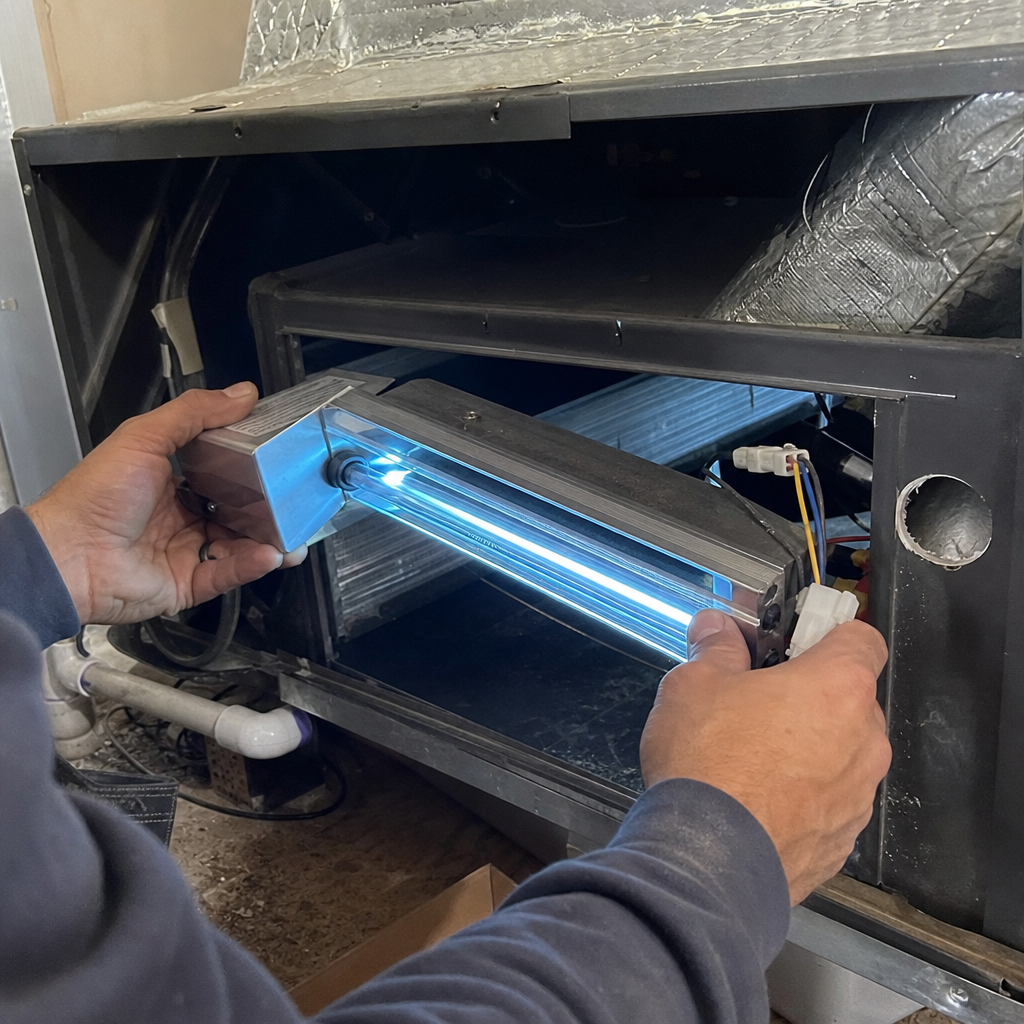
Installed in the plenum or near the evaporator coil, these continuously inhibit biological growth on the coil surface and in immediate airflow. They’re maintenance tools, not remediation solutions — useless for existing contamination in duct runs, but valuable for prevention in systems with chronic condensation issues. We specify Aprilaire and Honeywell UV systems where ongoing conditions warrant them, installed after cleaning and any necessary sealing work.
Cost impact: $400–$800 installed, depending on unit wattage and whether single or dual-lamp configuration is appropriate for your air handler.
| Service Component | Price Range |
|---|---|
| Standard air duct cleaning (contact-vacuum, full system) | $350–$650 |
| Add EPA-registered antimicrobial sanitizing | $150–$300 |
| UV-C light system installation | $400–$800 |
| Combined cleaning + sanitizing package | $450–$850 |
| Commercial system (per VAV unit or linear foot) | $0.35–$0.75/ft |
Why We Run Abatement Technologies Air Scrubbers During Sanitizing Work
Most residential duct cleaning operations skip this step entirely. We don’t, and it’s not because we’re billing extra — it’s built into our sanitizing protocol.
When we apply antimicrobial product in an occupied Allentown home, we deploy Abatement Technologies HEPA-filtered negative air machines to create containment. These units pull air from the work zone through HEPA filtration at 99.97% efficiency on 0.3 micron particles, exhausting filtered air outside or to an uncontaminated area. The purpose is twofold: protect occupants from airborne product during application, and prevent cross-contamination between duct zones during the process.
We’ve worked in tight South Side row homes where the return plenum sits four feet from the kitchen table. In those conditions, uncontrolled fogging would deposit product on surfaces where the family eats. The air scrubber isn’t marketing fluff — it’s how you do the work responsibly in real Allentown living spaces.
This equipment — Abatement Technologies, Nikro, Rotobrush — is the same caliber used in commercial remediation and healthcare-adjacent environments. We bought it because Larry got tired of renting inadequate tools or watching franchise crews show up with shop vacs and good intentions. Seventeen years of focused duct work teaches you where corners get cut, and we don’t cut that one.
Common Local Scenarios: When Sanitizing Makes Sense, and When It Doesn’t
These are actual situations we’ve handled across Allentown’s neighborhoods. They illustrate how we assess whether sanitizing adds value or just adds cost.
The Recent Home Purchase on the East Side
A family bought a 1920s semi-detached on Hanover Avenue, previous owners unknown, no maintenance records. Our inspection found moderate dust loading, some degraded flex liner, and light condensation staining in the basement return chase — but no active biological growth. We recommended full mechanical cleaning with duct sealing to address the condensation pathway, no antimicrobial. The staining was historical, not active. Adding sanitizing would have been unnecessary upsell, and Larry said so.
The South Side Row Home With a Musty Return
Occupied rental on Wyoming Street, tenant complaining of persistent musty smell from floor-level return. We found water staining on the concrete basement floor beneath the return trunk, organic debris accumulation, and active mold-adjacent growth on the trunk’s exterior insulation — with sporulation visible at the duct wall junction. Mechanical cleaning, antimicrobial application to the affected trunk section, replacement of water-damaged insulation, and sealing of the basement wall penetration. The product: EPA-registered quaternary ammonium formulation, 10-minute dwell time, full documentation provided to the landlord for insurance.
The West End Split-Level With Allergic Kids
Homeowner’s two children with diagnosed dust mite allergies, frequent nighttime symptoms. System was relatively clean — previous owners had maintained it — but the supply plenum and first six feet of trunk showed heavy organic loading consistent with long-term filter bypass (they’d been using fiberglass panel filters rated MERV 4). We cleaned thoroughly, upgraded to a properly fitted MERV 11 pleated filter, and installed a Honeywell UV system at the evaporator coil for ongoing biological inhibition. No antimicrobial needed — the problem was particulate and filtration, not biological contamination. The UV addresses the coil surface where condensation creates ongoing risk.
The Commercial Property Manager Downtown
Multi-unit building near Seventh Street, recurring tenant complaints about “stale” air after a water heater leak in the mechanical room. Our inspection found no duct contamination — the odor was from wet drywall in the mechanical room itself, migrating through a poorly sealed return air pathway. We sealed the return penetration, recommended drywall remediation to the building’s general contractor, and declined to sell duct sanitizing for a problem that wasn’t in the ducts. That property manager still calls us for actual duct issues across their portfolio.
Our Process: What Happens When You Call
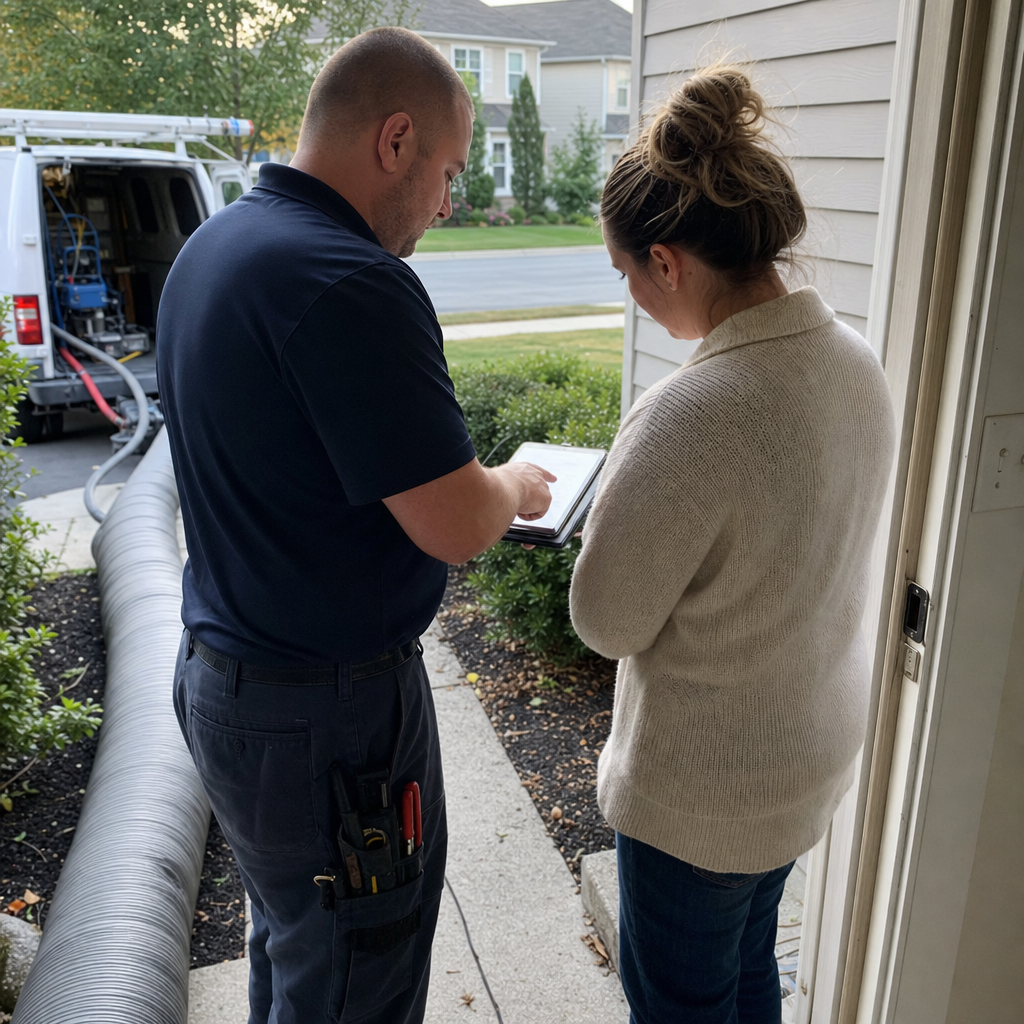
Larry shows up personally as Lead Technician — the person who built this business to nearly 800 verified reviews is the person who evaluates your system, not a subcontractor we’ve never met. Here’s how we handle sanitizing assessments:
- Visual inspection of accessible ductwork — we look before we quote, because “sanitizing” priced without seeing the system is guesswork
- Photo documentation of contamination type — we show you what we found, not just tell you
- Mechanical cleaning first, always — Rotobrush contact-vacuum or Nikro HEPA extraction depending on duct construction and debris type
- Post-cleaning evaluation — is biological contamination present on clean metal? If not, we’re done
- Targeted antimicrobial application if warranted — EPA-registered product, disclosed by name and registration number, with documented dwell time
- Abatement Technologies air scrubber containment during application — occupied-home protocol, no exceptions
- Final airflow verification and photo documentation — before/after records for your files
From cleaning to sealing to sanitizing, handled in one visit. No handoffs to separate contractors, no “we’ll send a specialist next week.”
FAQs
How Much Does Air Quality & Sanitizing Cost? (2026 Price Guide) — Allentown, PA: residential air duct sanitizing service ranges from $275–$550 when combined with prerequisite mechanical cleaning, or $150–$300 as an add-on to an existing cleaning. Commercial pricing runs $0.35–$0.75 per linear foot depending on system accessibility and contamination type. The exact figure depends on your system’s size, the number of supply and return runs, and whether we find active biological growth requiring full antimicrobial protocol or just preventive treatment. Call (888) 398-0831 for a free, exact quote — estimates are free, and we’ll tell you if you don’t need it.
EPA-registered antimicrobials can kill mold and mold spores on clean, accessible duct surfaces when applied with proper dwell time, but they cannot eliminate mold that has penetrated porous materials like degraded fiberglass liner or water-damaged duct board. In Allentown’s older row homes, we frequently find that physical removal of contaminated liner and sealing of condensation pathways is necessary before any chemical treatment becomes meaningful. If a company promises to “kill all mold” without inspecting what’s actually in your system, they’re selling hope, not science.
When performed with proper containment and EPA-registered products formulated for HVAC use, yes — but we take additional precautions in occupied homes with vulnerable occupants. Our Abatement Technologies HEPA air scrubbers create negative pressure during application, and we schedule dwell time with the system offline so no product circulates until fully dried. Larry will discuss any specific household sensitivities before product selection; not all antimicrobials are identical in their residual volatility profiles.
Searching for Air Quality & Sanitizing Near Me in Allentown, PA? You probably can’t tell from the register — and neither can we until we look. Musty odors, visible mold-like staining near vents, or recent water intrusion increase likelihood of biological contamination warranting sanitizing. But many “dirty duct” complaints resolve with thorough mechanical cleaning alone, especially in Allentown homes where the real problem is coal-era particulate, construction debris, or simple dust compaction from decades of neglect. We assess first, recommend second, and we don’t apply product you don’t need. I’ve been in a lot of duct systems in this city. Yours deserves a straight answer, not a sales pitch.
Ready for an Honest Assessment of Your Allentown Duct System?
Sequoia Air Duct & Vent Cleaning Greater Allentown has spent 17 years building a reputation for assessments you can trust — 756 verified reviews averaging 4.8 stars from homeowners and property managers who’ve learned that Larry Peterson’s crew tells the truth even when it costs us a upsell. Whether your ducts need mechanical cleaning, Best Air Quality & Sanitizing in Allentown, PA, or just a filter upgrade and better sealing, you’ll get the same straight answer we’d give our own neighbors.
Call (888) 398-0831 today for your free estimate. Larry handles every assessment personally, and we’ll schedule at your convenience — no pressure, no phantom problems, just clear information about what’s actually in your ductwork and what it takes to fix it right.
Written by Larry Peterson, Owner & Lead Technician at Sequoia Air Duct & Vent Cleaning Greater Allentown, serving Allentown, PA.