
Rotobrush Air Duct Cleaning in Allentown: A Homeowner’s Guide
Rotobrush air duct cleaning in Allentown typically costs $300–$600 for a standard residential system and works best on flexible ductwork and smaller homes where brush agitation plus integrated vacuum capture can reach every corner. For older Allentown homes with rigid sheet metal ductwork and decades of compacted debris, a high-CFM negative-pressure system often extracts significantly more material. If you’d rather not guess which method your home needs, call us at (888) 398-0831 — Larry shows up personally as Lead Technician to diagnose your system before recommending anything.
Here’s the mistake we see constantly: homeowners in Allentown’s West End or over in the 7th Street corridor hire a contractor based on equipment brand alone, as if “Rotobrush” were a magic word that guarantees clean ducts. It’s not. We’ve been inside hundreds of Allentown homes since 2009 — from the brick twins in Hanover Heights to the ranch houses off Cedar Crest Boulevard — and we’ve watched contractors run a brush through visibly filthy ducts, pack up, and leave behind material that a proper negative-pressure extraction would have removed. The equipment matters less than the judgment behind it.
How the Rotobrush System Actually Works
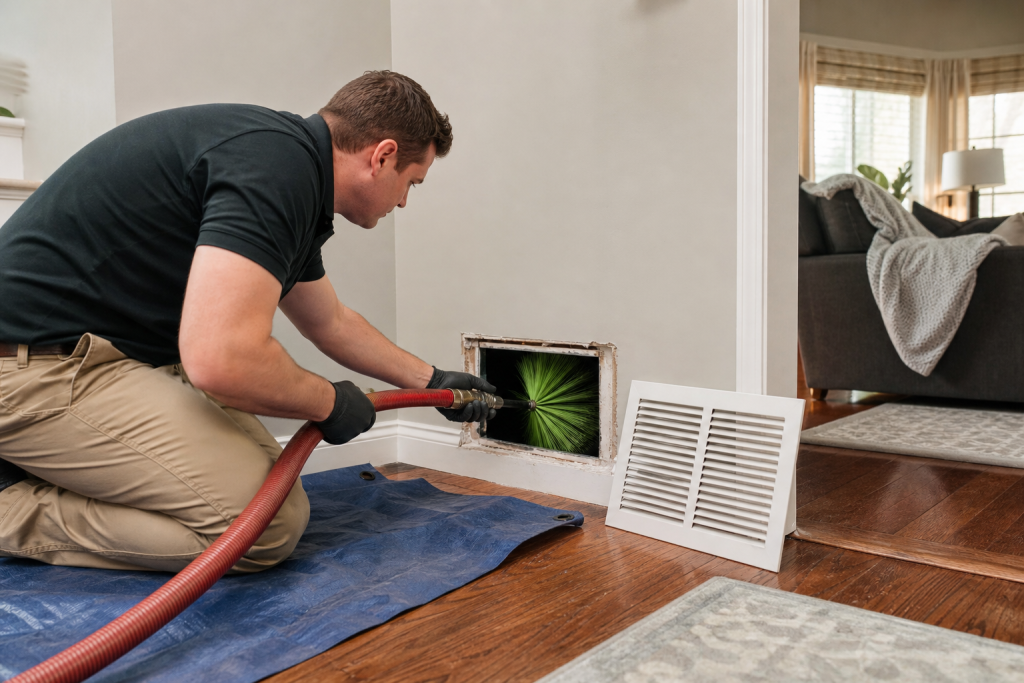
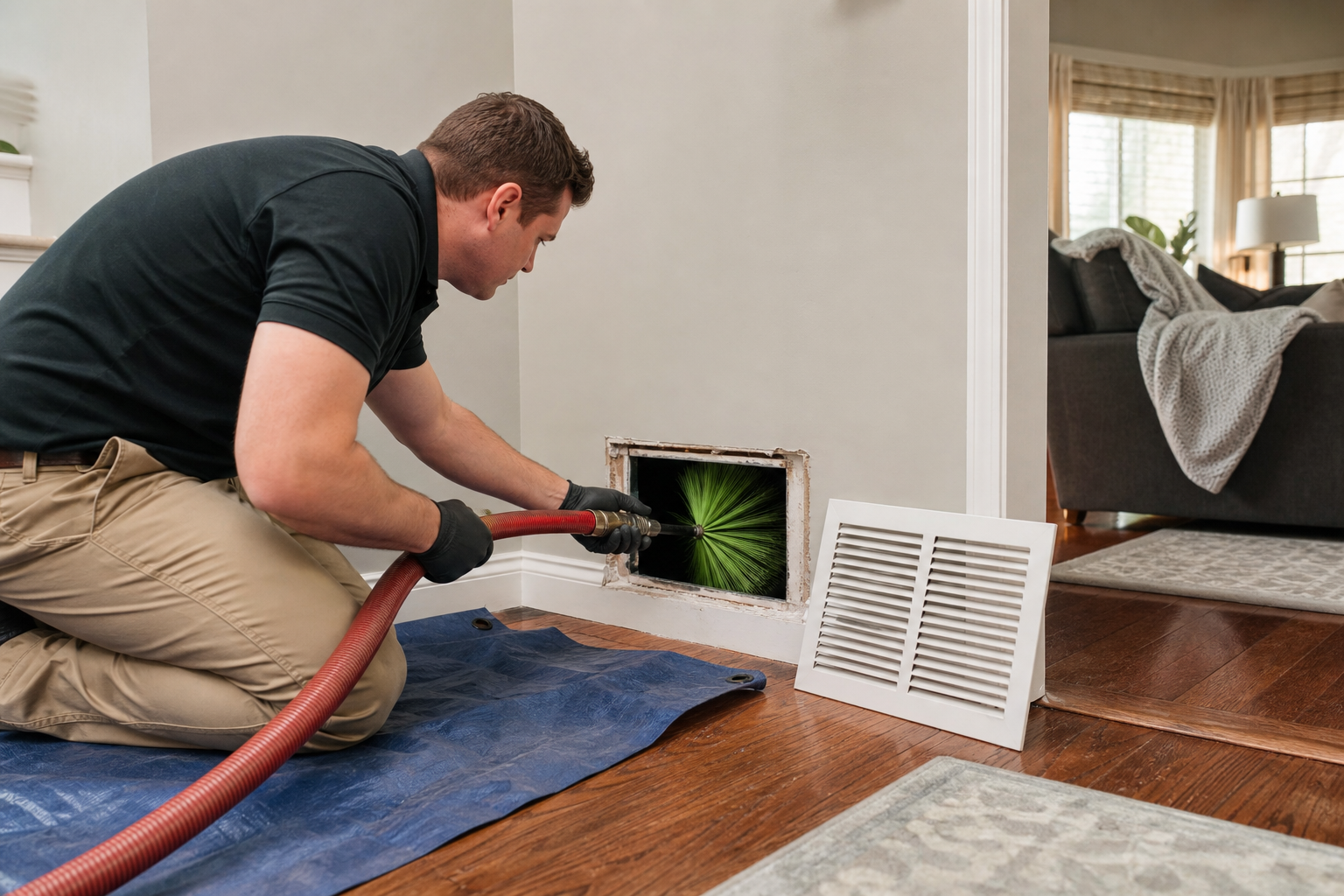
The Rotobrush design is mechanically straightforward and genuinely well-engineered for specific scenarios. A rotating brush head — typically polypropylene bristles on a flexible cable — spins at roughly 450–900 RPM while an integrated vacuum nozzle captures dislodged debris at the point of contact. The vacuum pulls through a HEPA filtration stage, and the whole assembly feeds through flexible ductwork on a long, steerable hose.
Where this design shines:
- Flexible ductwork: The brush conforms to corrugated interior surfaces that high-pressure air streams can skim past
- Tight radius bends: The steerable cable navigates elbows and transitions that rigid negative-pressure whips struggle to reach
- Light to moderate debris loads: Dust, pollen, and typical household accumulation respond well to contact agitation
- Smaller residential systems: The integrated vacuum has sufficient CFM for branch runs under 25 feet
In our experience across Allentown’s housing stock, the Rotobrush performs excellently on post-1980 homes with flex-duct additions — common in the split-levels around Parkland and the additions off Hamilton Boulevard. The brush physically scrubs the corrugated walls where negative-pressure tools can create suction gaps.
However, the integrated vacuum on most portable units tops out around 150–200 CFM. That’s adequate for light debris, but when we open a rigid metal trunk line in a 1920s Allentown twin and find an inch of compacted, greasy particulate? That load requires 2,000+ CFM and serious agitation — whips, skipper balls, or compressed-air tools — to break loose and transport to a collection point. The Rotobrush brush can actually compress dense debris against the duct wall rather than dislodge it, and the vacuum lacks the airflow to pull heavy material through long straight runs.
When Contact-Brush Systems Win — and When They Don’t
The honest matchup looks like this. We’ve run both methods in Allentown homes for 17 years, and the pattern is consistent enough that we can usually predict the right approach from a visual inspection of the register and a quick duct material check.
| Scenario | Rotobrush / Contact-Brush Advantage | Negative-Pressure / High-CFM Advantage |
|---|---|---|
| Flexible ductwork (insulated flex, semi-rigid) | Strong — brush conforms to corrugations, vacuum captures at source | Moderate — can collapse flex if pressure poorly regulated |
| Rigid sheet metal, light debris | Moderate — works, but slower per linear foot | Strong — whips + high CFM clean faster and more thoroughly |
| Rigid sheet metal, heavy/compacted debris | Poor — brush packs material, vacuum underpowered | Strong — mechanical agitation + transport airflow essential |
| Long straight trunk lines (20+ feet) | Poor — vacuum suction drops with hose length | Strong — truck-mounted blowers maintain CFM across distance |
| Multiple tight bends per branch | Strong — steerable cable navigates complex geometry | Moderate — whips can tangle, access points may be needed |
| Post-remediation or mold-sensitive environment | Moderate — HEPA capture is standard | Strong — Nikro HEPA units and Abatement Technologies air scrubbers offer medical-grade containment |
Last month we were in a home off Allen Street where the previous contractor had Rotobrushed the system twice in three years. The homeowner still had dust settling on furniture within days of each cleaning. We opened the rigid metal return trunk — original to the 1950s house — and found the brush had polished a channel through the center debris layer while leaving the perimeter packed solid. Two hours with our Nikro high-CFM unit and compressed-air whips pulled out roughly 18 pounds of material the contact method had never touched. That’s not a knock on Rotobrush; it’s a mismatch between tool and task.
How to Evaluate a Rotobrush Contractor’s Real Competence
Anyone can buy the equipment. The Rotobrush brand has done excellent marketing, and the machines are available to essentially anyone with a truck and a business license. What separates a competent operator from someone who made a purchase decision and hopes for the best?
Here’s what we look for when we’re called to re-clean after another contractor — which happens more often than we’d like in the Allentown market:
- They inspect before quoting. A contractor who walks in with a flat rate before seeing your duct material, system age, and access points is selling a process, not a solution. Larry shows up personally as Lead Technician on every estimate for this reason.
- They explain why they’re using this method on your specific system. “We use Rotobrush on everything” is a red flag. “Your flex-duct addition off the main trunk makes contact-brush the right approach for these branches, but we’re pulling the main trunk with negative pressure” indicates diagnostic thinking.
- They document with before-and-after camera inspection. Not a flashlight peek — actual borescope footage from inside the duct, timestamped, with the homeowner present if they want. We carry waterproof inspection cameras on every job. If a contractor won’t show you the inside of your own ducts, they don’t want you to see their work product.
- They own more than one class of equipment. A specialist who invested only in Rotobrush has a financial incentive to use it everywhere. Our fleet includes Rotobrush units for appropriate jobs, Nikro HEPA-rated negative-pressure systems for heavy extraction, and Abatement Technologies air scrubbers for containment-sensitive environments — because the right tool depends on the house, not our inventory.
Nearly 800 verified reviews don’t accumulate by forcing one method on every system. They come from matching the approach to the actual condition we find.
What Proper Documentation Should Look Like
The camera doesn’t lie, and in 17 years of focused duct work, we’ve learned that documentation is the only protection for both contractor and homeowner. After any cleaning — Rotobrush or otherwise — you should receive:
- Pre-cleaning borescope images from multiple branch lines and the main trunk, with debris visible and identifiable
- Post-cleaning images from the identical locations, showing clean duct walls with consistent lighting and camera angle
- Debris collection documentation — weight or volume of material removed, with timestamp
- Written assessment of any damage, corrosion, or accessibility issues encountered
We did a job last spring in a rental over on the South Side where the property manager needed documentation for a tenant dispute about air quality. Because we’d shot full video from register to plenum, we could demonstrate exactly what was removed and where the system remained structurally sound. That’s not extra service — that’s minimum professional practice.
If a Rotobrush contractor tells you “the brush and vacuum do the work, no need to look inside,” they’re asking you to trust a process you can’t verify. In our experience, the contractors who resist camera documentation are the ones who know their results won’t hold up to scrutiny.
The Honest Conversation About Method Selection
This is the part that gets us worked up, and we’ll be direct about it: any contractor who uses one cleaning method for every job regardless of system type is prioritizing their equipment investment over your home’s specific needs. Full stop.
We’ve seen this in Allentown’s older neighborhoods especially — contractors who bought a Rotobrush package, attended a weekend training, and now apply it universally because it’s what they own. Same for truck-mount operators who blast high CFM through fragile flex-duct and damage it. The method should follow the diagnosis, not the other way around.
At Sequoia Air Duct & Vent Cleaning Greater Allentown home, our approach is:
- Visual inspection of registers, returns, and accessible ductwork
- Borescope assessment of internal conditions where access allows
- Method selection based on duct material, debris type, system configuration, and any health sensitivities in the household
- Execution with appropriate equipment — which may mean Rotobrush on some branches and negative-pressure extraction on others
- Post-cleaning verification with camera documentation
From cleaning to sealing, handled in one visit. That’s not a slogan — it’s how you avoid paying twice because the first contractor guessed wrong.
When to call a pro: If you can see debris in your registers, smell musty or stale air when the system runs, or have noticed your energy bills climbing without explanation, your ducts need professional assessment. Don’t attempt to access or clean ductwork yourself — sheet metal edges can cut severely, and disturbing mold-contaminated material without proper containment creates health risks.
Related services in Allentown: If your system needs more than cleaning, we also offer Air Duct Cleaning in Allentown, Dryer Vent Cleaning in Allentown, and HVAC Cleaning in Allentown — all performed by Larry personally, with the same equipment-serious approach.
The Bottom Line
Rotobrush air duct cleaning is a legitimate, well-engineered method that performs excellently on flexible ductwork and smaller residential systems with light to moderate debris. It is not universally superior, and in older Allentown homes with rigid metal ductwork and heavy accumulation, high-CFM negative-pressure extraction will typically produce better results. The contractor who diagnoses your system before selecting equipment — and who can explain why they chose that method — is the contractor worth hiring.
Key takeaways:
- Rotobrush excels on flex-duct and tight bends; high-CFM systems win on rigid metal with heavy debris
- Equipment brand matters less than diagnostic competence and method matching
- Before-and-after camera documentation is non-negotiable for verifying any cleaning claim
- Contractors using one method for every job are serving their inventory, not your home
- Allentown’s housing age mix — from 1920s twins to new construction — demands flexible expertise, not rigid process
If you’re in Allentown and want an honest assessment of what your specific duct system needs, Sequoia Air Duct & Vent Cleaning Greater Allentown offers free estimates. Larry shows up personally as Lead Technician, diagnoses your system on site, and recommends only what will actually work. Call (888) 398-0831 to schedule — estimates are free, and we carry the full equipment range to match the method to your home.
Frequently Asked Questions
Rotobrush air duct cleaning in Allentown typically runs $300–$600 for a standard residential system with 8–12 registers, though final pricing depends on duct material, system accessibility, and debris load. Homes with rigid metal trunk lines requiring additional negative-pressure extraction may fall toward the higher end. Call (888) 398-0831 for an exact quote — estimates are free.
Rotobrush cleaning is better for flexible ductwork and systems with tight bends where contact agitation reaches surfaces that air tools miss; traditional high-CFM negative-pressure cleaning is better for rigid metal ductwork with heavy, compacted debris. The “better” method depends entirely on your home’s duct configuration, not the brand name. A competent contractor evaluates first, then selects equipment.
Rotobrush cleaning can damage deteriorated flex-duct if the brush is oversized for the duct diameter or if the duct is already brittle from age; on rigid metal ductwork, mechanical damage is rare but the brush can compact heavy debris rather than remove it if the vacuum CFM is insufficient. This is why pre-cleaning inspection matters — we assess duct condition before selecting any tool.
You know your ducts were cleaned properly when the contractor provides timestamped before-and-after borescope video from inside your ducts, shows you debris volume or weight removed, and your registers remain clean with reduced dust accumulation for months afterward. If a contractor won’t document their work or guarantees results without seeing your system first, that’s your answer. Call (888) 398-0831 if you need a second opinion — we document every job.
Written by Larry Peterson, Owner & Lead Technician at Sequoia Air Duct & Vent Cleaning Greater Allentown, serving Allentown since 2009.
Need Air Duct Cleaning Help?
Call Sequoia Air Duct & Vent Cleaning Greater Allentown — licensed & insured, here with fast after-hours help in Allentown.
(888) 398-0831