
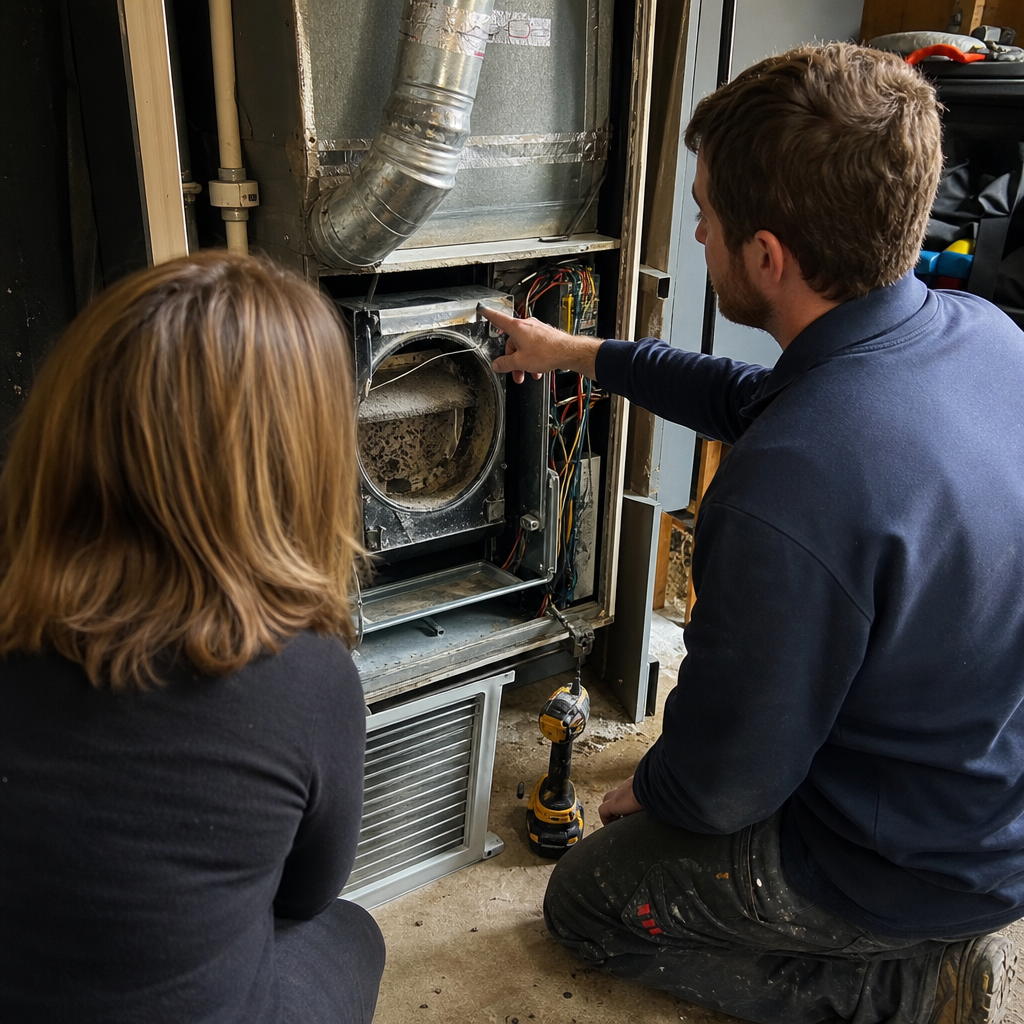
Signs You Need Dryer Vent Cleaning in Allentown, PA — From Standard Warnings to Row-Home Risks Most Guides Miss
The most reliable signs you need dryer vent cleaning are clothes that stay damp after a full cycle, a dryer exterior that feels unusually hot, and a burning lint smell during operation. In Allentown’s older housing stock, especially the South Side and East Side row homes built during the industrial era, two additional warning signs appear later and carry higher fire risk: weak airflow at the exterior cap combined with lint accumulation on the cap face, and visible lint debris around your floor-level dryer connection in a finished basement. If you’re noticing any of these, call (888) 398-0831 — we can assess it same-day and give you a straight answer on whether cleaning is actually needed.
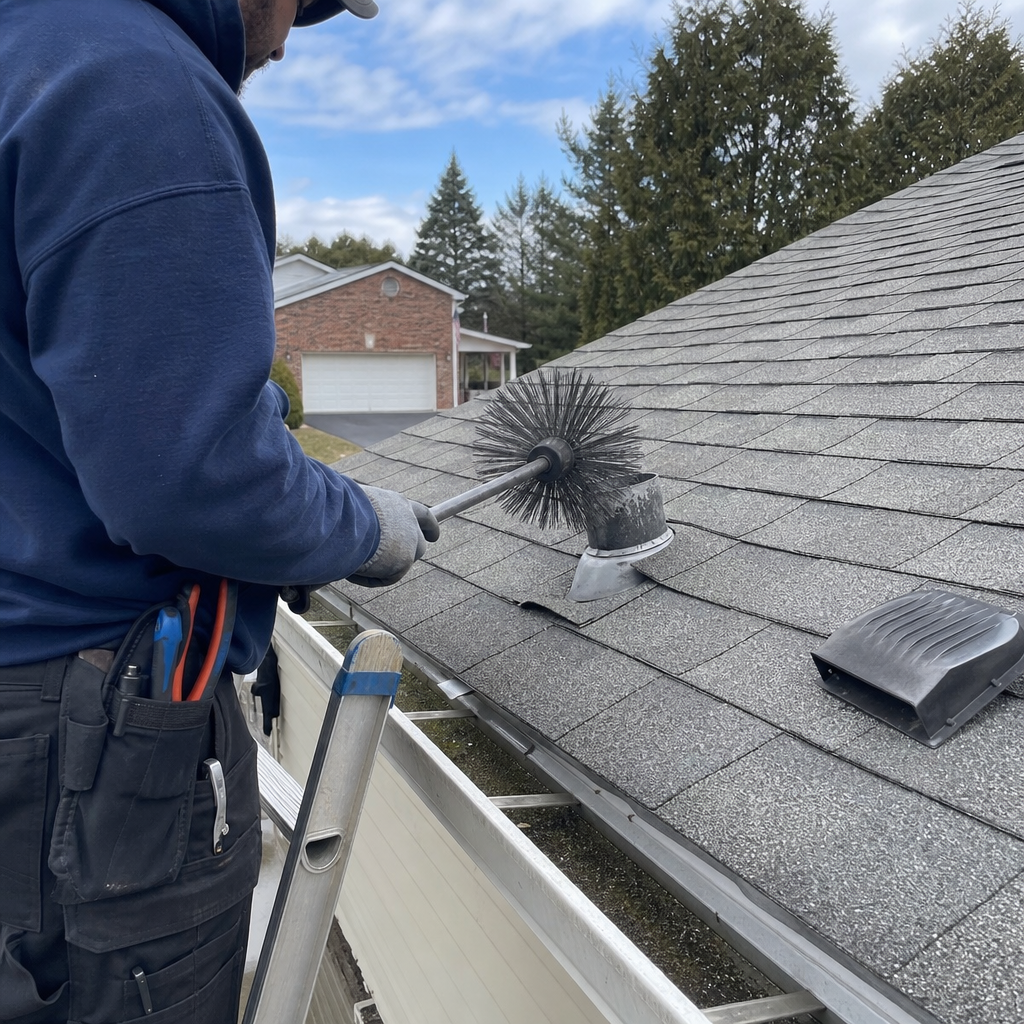
Most articles about dryer vent warning signs were written for ranch homes and split-levels where the vent runs eight feet straight through an exterior wall. That advice still matters, but it doesn’t prepare you for what we find in Allentown’s multi-story row homes, where vent runs often stretch 15 to 30 feet through multiple offsets before exiting four stories up through exterior brick. The physics change when the run gets longer, and so do the warning signs — they show up later, when the clog is more severe, and the fire risk is higher.
We’ve been cleaning dryer vents across the Lehigh Valley for 17 years, and the jobs that worry us most aren’t the ones where the homeowner caught it early. They’re the row-home systems where the dryer “still worked, just slowly” for three or four years while a lint plug compacted into something resembling felted wool halfway up a vertical chase. Larry Peterson, our Owner & Lead Technician, has pulled plugs from South Side row homes that measured nearly two feet in length — the homeowner had no idea because the extended run’s natural resistance masked the gradual performance decline.
The Standard Warning Signs — Still Worth Knowing
Before we get to what makes Allentown different, let’s confirm the baseline symptoms that apply everywhere. These are the signs every homeowner should recognize, and they’re genuinely useful — we just don’t want you stopping here if you live in a 1920s row home on the South Side.
- Extended drying cycles: A load that used to take 45 minutes now needs 70 or 80, or requires two cycles to feel fully dry. This is the most common early warning, though in long vent runs the degradation happens so gradually that homeowners adapt without realizing.
- Hot dryer exterior: The cabinet or control panel feels unusually warm to the touch. This indicates restricted exhaust airflow forcing heat back into the machine.
- Burning smell: Any acrid, lint-like odor during operation means lint is likely accumulating near the heating element or in a restricted section of the run.
- Excess lint in the lint trap or around the door seal: If the trap is packed after every load, or lint is escaping around the door, your exhaust airflow isn’t carrying debris out properly.
- Humid laundry room: Moisture that should be vented outside is instead condensing in the room, often visible on windows or walls near the dryer.
These signs are real and actionable. But here’s where the standard advice falls short for Allentown: in a short, straight vent run, you’ll notice extended drying times almost immediately because there’s nowhere for the restriction to hide. In a 25-foot run with two 90-degree offsets through uninsulated wall cavities — the configuration we see constantly in pre-WWII row homes retrofitted with forced-air systems — the same restriction produces a much smaller performance drop. The system has more “headroom” to absorb the degradation before you notice your jeans are still damp.
The Two Row-Home Warning Signs Most Articles Never Mention
After 17 years of focused duct and vent work in Allentown, we’ve identified two warning signs that are especially relevant to the city’s dense, multi-story housing stock. These appear in row homes, twin homes, and converted worker cottages across the South Side, East Side, and parts of the West End where exterior brick construction and vertical vent runs are the norm.
Lint Accumulation at the Exterior Cap with Weak Airflow on Short Cycles
This combination — visible lint clinging to the cap face or louvers, plus airflow that feels noticeably weaker even when you run the dryer on a 20-minute timed cycle — indicates a compacted clog somewhere in the middle of a long run. Here’s why it happens: in an extended vent with multiple bends, lint doesn’t distribute evenly. It builds at restriction points — the offset joints, sagging sections of flex duct, or transitions between materials — until it forms a dense plug. The dryer still pushes some air through, so you don’t get the dramatic “clothes won’t dry” failure of a short-run blockage. Instead, you get gradual compaction over months or years, with lint slowly working its way out the cap because the internal pressure is high enough to force debris through partial openings but not enough to clear the system.
We see this constantly in Allentown’s row-home conversions from the 1960s and 70s, where supply trunks and dryer vents were run through the narrow gap between exterior brick and interior plaster — essentially an uninsulated outdoor chase exposed to temperature swings. The condensation in those chases causes lint to clump and adhere to duct walls, accelerating compaction. When Larry shows up personally as Lead Technician on these jobs, he’ll often find the first half of the run relatively clear and the second half — especially the vertical section — packed solid. The homeowner noticed the cap lint but assumed it was normal because the dryer still functioned.
Visible Lint Debris Around the Floor-Level Dryer Connection in a Finished Basement
This sign is easy to miss because it looks like ordinary dust or a minor housekeeping issue. But if you’re finding lint accumulation on the floor, walls, or shelving near where your dryer connects to the wall duct in a basement — especially a finished basement where that connection is enclosed in a soffit or cabinet — it indicates back-pressure from a blocked extended run. The exhaust air is finding the path of least resistance backward through small gaps in the connection rather than pushing through the restriction ahead.
In Allentown’s row homes, these connections are often buried in basement chases that were never designed for ductwork, squeezed between original floor joists and later-added framing. The connection points are hard to inspect and rarely sealed properly. When back-pressure occurs, lint escapes into the basement environment — a genuine concern if your basement houses a gas-fired furnace or water heater, since lint is highly combustible and those appliances need clean combustion air.
We’ve pulled out not just lint from these systems but degraded mortar particles, spider debris, and fiberglass from deteriorated flex duct that was stapled in decades ago and forgotten. That’s the reality of working in housing stock that was built for coal heat and later adapted without the structural modifications that would have made forced-air systems appropriate.
Why Long Vent Runs Mask Problems Until They’re Serious
The relationship between vent length, restriction, and warning signs isn’t intuitive. A short, straight run has low baseline resistance, so any additional restriction — a bird nest, a lint buildup, a crushed section — immediately spikes the back-pressure and produces obvious symptoms. A long run with multiple offsets already has elevated baseline resistance. The dryer works harder from day one, and you unconsciously adapt to slightly longer cycles. When restriction builds, it adds to an already-high baseline rather than jumping from low to high. The absolute pressure might be worse than in a short run, but the change is smaller and harder to perceive.
This is why we recommend proactive inspection for any Allentown row home with a vent run exceeding 15 feet or with more than one offset — even if you’re not noticing dramatic symptoms. The U.S. Fire Administration attributes roughly 2,900 residential dryer fires annually to lint buildup, and the risk scales directly with restriction severity and vent length. A compacted plug in a 25-foot vertical run is a fundamentally different fire scenario than a surface coating in an eight-foot horizontal run.
Our equipment for these jobs includes Rotobrush contact-vacuum systems and Nikro HEPA-rated extraction units — tools that can navigate extended runs and remove compacted material without damaging older ductwork. We also use Abatement Technologies air scrubbers when we’re working in finished basements to protect indoor air quality during the cleaning process. These aren’t consumer-grade tools; they’re the same systems used in commercial and remediation environments where thoroughness matters.
The Warning Sign Almost Every Guide Omits: Nesting in the Exterior Cap
Here’s something we find several times per year that never makes the generic lists: birds, bees, or insects have nested in or around the exterior vent cap. This is especially common in Allentown row homes where caps are mounted high on exterior brick walls, often above the third or fourth floor, and not easily inspected from ground level. A partially blocked cap might still allow some airflow, so the dryer functions adequately while the nest grows. By the time you notice symptoms, the restriction is severe and the nest material itself is often combustible.
We’ve removed sparrow nests packed with twigs and grass, mud-dauber wasp constructions that nearly sealed the cap entirely, and in one memorable case on the East Side, a squirrel’s cache of acorns stuffed into a cap that had lost its flapper door. The homeowner’s dryer had been “a little slow” for two years. Larry’s assessment: “I’ve been in a lot of duct systems in this city. Yours deserves a straight answer, not a sales pitch.” The acorn cache was the straight answer.
If your cap hasn’t been physically inspected in the past year — and you can’t safely do so yourself due to height — that’s reason enough to schedule a professional assessment. We carry extension inspection cameras and can document cap condition without ladder work in many cases.
How Allentown’s Climate and Geography Compound the Problem
Allentown sits in the Lehigh Valley floor, flanked by Blue Mountain to the north and South Mountain to the south. That bowl-shaped geography traps humidity and particulates during temperature inversions, pushing more airborne debris into recirculating systems than hilltop communities like those above the ridge in northern Lehigh County. Our hot, humid summers create condensation risk inside the older, under-insulated ductwork common in the city’s historic housing stock — and that condensation causes lint to clump and adhere rather than flowing through smoothly.
The region’s freeze-thaw cycles also stress exterior caps and the caulking around roof or wall penetrations, creating gaps that invite nesting and allow moisture intrusion. We routinely find caps in Allentown’s row homes that haven’t been properly maintained since installation, sometimes decades ago. A $15 cap replacement can prevent a $200+ cleaning or worse — but you need someone who’ll actually look at it and tell you honestly, not just run a brush through and invoice you.
What Professional Dryer Vent Cleaning Costs in Allentown
Pricing depends on vent configuration, accessibility, and severity of buildup. For standard residential dryer vent cleaning in Allentown, most homeowners fall within these ranges — see our full How Much Does Dryer Vent Cleaning Cost? (2026 Price Guide) — Allentown, PA for detailed breakdowns:
| Service Component | Typical Range |
|---|---|
| Standard dryer vent cleaning (straight run, ground-floor access) | $125 – $185 |
| Extended run cleaning (15+ feet, multiple offsets, row-home vertical runs) | $195 – $295 |
| Exterior cap replacement or repair | $45 – $85 |
| Transition hose replacement (behind dryer) | $35 – $65 |
| Video inspection of full run | $75 – $125 (often waived with cleaning) |
We don’t quote over the phone for row-home jobs without asking about run length, floor count, and exterior access — those variables change the scope significantly. Estimates are free, and we’ll tell you if your situation is straightforward enough that you could reasonably handle it yourself. Dryer Vent Cleaning is our specialty, not a side service, so our assessment reflects actual field experience rather than a generic checklist.
Our home page has more detail on our full scope, from duct cleaning and sealing to air quality assessments using Aprilaire and Honeywell IAQ products.
When to Call vs. What You Can Check Yourself
There are two things every homeowner should do monthly: clean the lint trap thoroughly (run water over it — if water beads up, there’s invisible residue reducing airflow) and verify that the exterior cap flapper moves freely when the dryer runs. Beyond that, the line gets blurry.
We do not recommend DIY cleaning for extended vertical runs, especially in multi-story row homes where the vent passes through unconditioned wall cavities or exterior chases. The risk of dislodging a section of older flex duct, damaging a concealed joint, or compacting a partial blockage into a complete obstruction exceeds the cost of professional service. Gas dryers add combustion safety concerns — improper reconnection can introduce carbon monoxide risks that aren’t present with electric units.
If you have any of the row-home-specific warning signs described above, or if your vent run exceeds 15 feet with multiple offsets, professional assessment is the prudent choice. Larry shows up personally as Lead Technician, evaluates the actual configuration, and gives you a clear recommendation without upsell pressure. From cleaning to sealing, handled in one visit — no handoffs to subcontractors.
Key Takeaways for Allentown Homeowners
- The standard warning signs (long dry times, hot exterior, burning smell) still matter, but they appear later and less dramatically in extended vent runs.
- Row-home residents should watch specifically for lint accumulation at the exterior cap combined with weak airflow, and for lint debris around floor-level connections in finished basements.
- High-mounted exterior caps in multi-story brick construction are vulnerable to nesting — an often-overlooked fire risk that requires physical inspection.
- Allentown’s humid summers and valley-trapped particulates accelerate lint compaction in under-insulated, older ductwork.
- Proactive inspection is warranted for any vent run over 15 feet or with multiple offsets, even without dramatic symptoms.
FAQs
Most standard residential dryer vent cleanings in Allentown range from $125 to $185, while extended row-home runs with multiple offsets typically run $195 to $295. We provide free, no-pressure estimates after asking about your specific vent configuration — call (888) 398-0831 for exact pricing based on your home’s layout, or learn more about our Affordable Dryer Vent Cleaning in Allentown, PA.
For short, straight, easily accessible vents, DIY cleaning with a basic kit can work. For Allentown’s row-home extended runs — especially vertical chases through multiple floors of exterior brick — Best Dryer Vent Cleaning in Allentown, PA is safer and more thorough, with less risk of damaging concealed ductwork or creating a complete blockage. The cost difference is often smaller than the cost of repairing a DIY mistake.
Annual inspection is prudent for any home; actual cleaning frequency depends on usage and vent configuration. For Allentown row homes with extended runs, we recommend professional inspection every 12–18 months and cleaning every 2–3 years minimum, or sooner if you notice any warning signs. Homes with heavy laundry usage, multiple residents, or pets that shed may need more frequent service.
We offer same-day and next-day appointments for suspected blockages, especially when burning smells or severely extended dry times indicate potential fire risk. Call (888) 398-0831 — we’ll ask a few quick questions about your symptoms and vent setup, then schedule Larry to assess it personally. Emergency priority goes to situations with active burning odors or gas dryer concerns.
If you’d rather have it looked at, Sequoia Air Duct & Vent Cleaning Greater Allentown offers a no-pressure assessment in Allentown — call (888) 398-0831.
Written by Larry Peterson, Owner & Lead Technician at Sequoia Air Duct & Vent Cleaning Greater Allentown, serving Allentown, PA.